
Nazrul and the Power of the Press
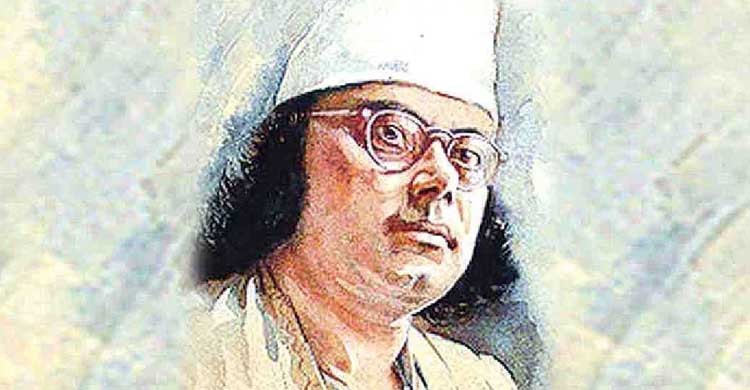
When critics assess the contributions of a versatile genius like Kazi Nazrul Islam, they often concentrate on his poetry, short stories, novels, plays, essays, and songs. Yet beyond his literary and musical achievements lie several noteworthy aspects of his life that receive far less attention. Among these is his brief but impactful career in journalism.
Following the end of World War I, Kazi Nazrul Islam arrived in Kolkata in March 1920 and took residence at the office of the Bangiya Mussalman Sahitya Samiti, which published the monthly magazine ‘Moslem Bharat’. At the editor’s request, he allowed his novel ‘Badhon Hara’, an epistolary work that brought him his first taste of widespread recognition, to be printed in it.
During this period, Nazrul also wrote for journals such as ‘Bangiya Mussalman Sahitya Patrika’, ‘Upasona’, and ‘Sawgat’. However, his journey in journalism truly began with the publication of the daily ‘Nabajug’. First issued on July 12, 1920, the evening newspaper quickly gained popularity among readers, largely due to Nazrul’s powerful and engaging writing style.
Despite having no prior experience in editing, Nazrul impressed readers and colleagues alike with his command of language. He demonstrated a modern journalistic approach by presenting complex news in a concise and accessible manner. Through ‘Nabajug’, he addressed pressing issues faced by ordinary people. A collection of his articles from the paper was later published as ‘Jugabani’ in October 1922, though it was subsequently banned by the British authorities.
When ‘Nabajug’ ceased publication in February 1921 due to internal disputes, Nazrul joined the monthly ‘Nowroj’, which itself closed within a few months. In May 1922, he moved to the daily ‘Shebok’, but it too was shut down after its editor, Maulana Akram Khan, was arrested for supporting the Swadeshi Movement.
Nazrul then joined the editorial team of the daily ‘Mohammadi’, where his satirical column Katukutu gained immense popularity for its wit and sharp language. However, he left the paper after a disagreement over editorial interference in his tribute to poet Satyendranath Dutta.
Soon after, Hafiz Masud Ahmed invited him to edit a new publication. Nazrul proposed a bi-weekly format and named it ‘Dhumketu’. First published on August 11, 1922, the paper burst onto the scene like a comet, earning immediate acclaim for its bold editorials and fiery poetry.
In ‘Dhumketu’, Nazrul published the symbolic poem Anondomoyir Agomone, which sharply criticised British rule. On October 13, 1922, he explicitly demanded complete independence through its pages, an unprecedented stance at the time. The colonial government branded his writings as seditious, leading to his arrest on November 23, 1922. He was sentenced to one year in prison on January 16, 1923.
During his trial, Nazrul delivered a powerful statement later published as Rajbondir Jobanbondi. While imprisoned, he went on a hunger strike to protest mistreatment by jail authorities and was eventually released on December 23, 1923. His editorials from ‘Dhumketu’ were later compiled into ‘Durdiner Jatri’ (1926), which was also banned.
Nazrul later joined the Labour Swaraj Party, affiliated with the Indian National Congress. He became chief director of the party’s weekly ‘Langal’, launched on December 25, 1925. The paper published some of his most celebrated works, including Samyabadi, Krishoker Gaan, and Sabyasachi. Although ‘Langal’ ceased publication in April 1926, it re-emerged as ‘Gonobani’ in August, where Nazrul wrote influential essays promoting communal harmony.
In 1927, a collection of his essays titled ‘Rudra Mangal’, drawn from ‘Dhumketu’ and ‘Gonobani’, was published only to be banned once again by the colonial regime. That same year, he joined the weekly ‘Sawgat’, where he edited the Chanachur section, known for its progressive stance against social, political, and religious orthodoxy. His novel ‘Kuhelika’ was also serialised there.
Afterward, Nazrul stepped away from journalism to focus on music. He briefly returned in 1941 as the editor of ‘Nabajug’, revived under the patronage of AK Fazlul Huq. However, his career was cut short due to illness that eventually robbed him of his voice and memory.
For the next 34 years, from July 1942 to August 1976, Nazrul lived in painful silence. He passed away on August 29, 1976, in Dhaka.
Throughout his life, Nazrul stood firmly against injustice and inequality, advocating for the rights of the oppressed. Journalism provided him with a powerful platform to engage directly with the masses and respond to the socio-political realities of his time.
Though brief, his career in journalism played a crucial role in shaping his worldview and enriching his literary voice, making it essential to understanding his broader social and political philosophy.
(The writer is a senior journalist. He is currently working at the Daily Sun)