
Through her silence
Qudsia Huda Deepa is an international expert on global health diplomacy, as well as a writer and poet. She is a staunch advocate for gender equality, equity, and human rights.
In her fortnightly column - ‘Through Her Silence’, Qudsia writes about women navigating life under the weight of invisible expectations. Drawing from personal memory and global reality, she examines how equality often exists more as promise than practice. The column highlights how women across cultures absorb responsibility quietly, without applause or recognition. Through lived experience and observation, she explores how silence becomes both shield and survival. The piece unravels the illusion of equality and the unseen labour women continue to carry throughout their lives. A powerful beginning to a column that keeps readers wonder
Episode 1: The Illusion of Equality
It was a November morning, some twenty five years ago, when the phone rang in our little apartment in Attleboro, breaking the stillness of a winter dawn.
“Dee! Look outside!” My older and only sister’s voice burst through the line from her home in New York.
Still half asleep, I walked to the window and drew back the heavy drapes.
“Ah… my God. What is that?”
The world beyond lay covered in pristine white snow. Vast, luminous, untouched. I stood frozen in the warmth of the heating system, mesmerised by its beauty, an expanse so pure it reminded me of a young girl standing at the threshold of becoming. I was spellbound.
But the spell did not last long.
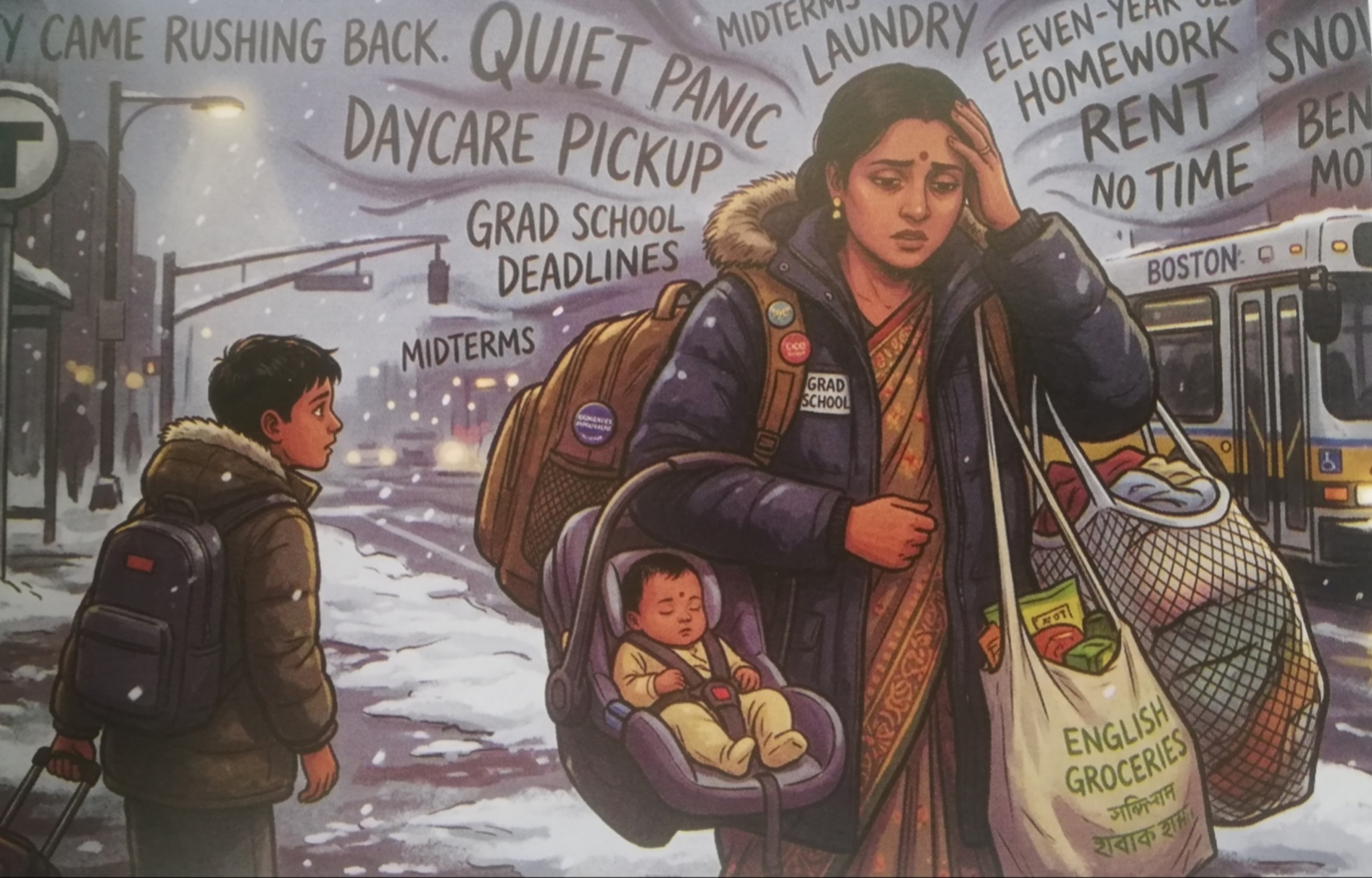
Reality came rushing back with a quiet panic. How was I going to manage this now? Driving a baby and an eleven year old back and forth to daycare and middle school, the long commute to grad school, groceries, laundry and the list could only grow long. Responsibilities lined up, one after another, as if they had always been waiting. Life as a graduate student under the cover of a Bengali mother in a foreign land had shifted again, this time wrapped in the unforgiving winter of Boston.
I did what women, or more precisely mothers, often do.
I accepted. I adapted. I moved forward.
It was only much later that I grasped the quiet lesson embedded in that moment. What we celebrate as progress, or politely label evolution, often comes at a price that is never openly discussed. For women, that price takes the shape of fewer real choices carried alongside an ever widening set of expectations. We soften them with words like duties, roles, or responsibilities, rarely stopping to ask why they gather so naturally at our feet.
The world insists it is moving forward, and it points to policies, milestones, confident headlines, and political promises as proof. Equality is declared, celebrated, and neatly filed away as achieved. Yet women experience this so called progress differently. It rarely moves in a straight line for ‘her’ . More often it circles back on itself, sometimes spiralling until it drifts away from everyday reality. The language has changed, but the weight has not. Only the packaging has become easier to digest.
In Bangladesh, this contradiction plays out in plain sight. Women power the garment industry that fuels the economy, yet many work for fragile wages under unsafe conditions. Girls attend school in greater numbers than ever before, but early marriage, domestic expectations, and social pressure continue to interrupt education and quietly narrow ambition. Support exists, but with invisible strings attached. Equality is spoken aloud, then carefully renegotiated behind closed doors.
This pattern is not confined to developing nations. In countries labelled developed, inequality often arrives wearing softer language and progressive intent. Women enter universities, corporate offices, and leadership roles, yet expectations tighten as responsibilities multiply. When New Zealand’s Prime Minister Jacinda Ardern led her country through crisis while becoming a mother, admiration echoed around the world. Beneath that admiration, however, lingered surprise. Leadership paired with motherhood was treated as remarkable. Men, by contrast, are rarely asked how fatherhood fits into power.
Across cultures, women are asked to juggle choices that are often false to begin with. Career or caregiving. Strength or likeability. Ambition or acceptability. Even after a choice is made, the rules have a habit of shifting mid course. Balance is offered as the solution, yet remains stubbornly out of reach.
During the pandemic, millions of women stepped away from paid work, not because ambition faded, but because care responsibilities settled where they always seem to land. Choice became the language used to soften necessity. When systems faltered, women quietly became the system, holding things together with very little fuss and even less credit.
Over time, many women learn to speak less. Not because they lack opinions or conviction, but because silence can feel like protection. Through her silence, households function, economies stabilise, societies recover. The strain is absorbed without ceremony, rarely acknowledged, almost never measured.
Until progress is judged by shared responsibility rather than public proclamation, equality will remain something we talk about more than we live. It will look convincing on paper, sound right in speeches, and feel thin when tested against everyday life.
And so the illusion persists. Quietly. Persistently. Through her silence.
I paused here while reading this piece aloud at home to my two women over phone.
“Ma,” one of them said, carefully, “equality still sounds like something being discussed, almost negotiated. It should be clearer that it is not up for debate.”
She was right.
Equality that exists only on paper is not progress. It is postponement.
And until that changes, no matter how polished the narrative or well intentioned the promise, the burden will continue to fall where it always has.
I rest my case.