
RAJUK Flags Unauthorized Floors, Illegal Shop Expansion at Bashundhara City
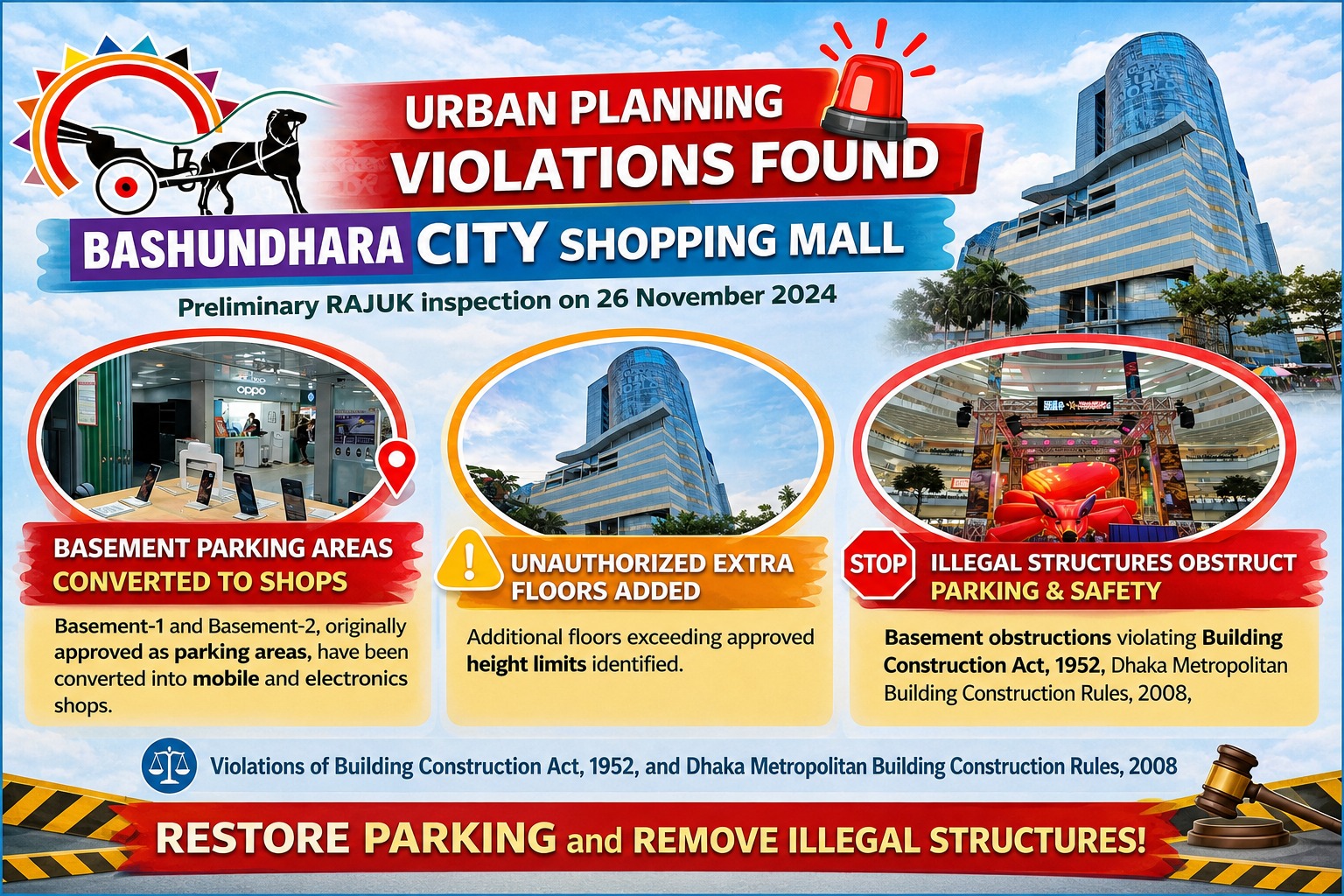
The long history of urban planning violations and legal irregularities surrounding Bashundhara City Shopping Mall is no longer a matter of “rumor,” but has emerged—through RAJUK’s preliminary investigation—as a systematically ironic reality. Allegations suggest that for the past 15 years, under the shadow of influential quarters, this commercial establishment has effectively operated under its own set of rules, where the approved design functions merely as an “optional guideline.” Based on complaints received through RAJUK’s Grievance Redress System (GRS), a field inspection was conducted on 26/11/2024.
The inspection revealed that Basement-1 and Basement-2 of Bashundhara City Shopping Mall have been transformed from designated parking zones into a vast mobile and electronics marketplace. Where vehicles were originally meant to be parked according to the approved plan, there now exists a “kingdom of smartphones” and an “empire of gadgets”—as if urban planning has been replaced by a commercial fantasy. According to the approved design, Basement-1 was intended to be partially commercial and partially parking, while Basement-2 was designated entirely for parking. In reality, however, both basements have been converted into rows of retail shops, rendering the concept of parking a mere footnote in an outdated blueprint. As a result, surrounding roads have turned into a “permanent festival” of traffic congestion, further deepening the irony of Dhaka’s urban mobility crisis. The inspection also found that construction has exceeded the approved height limits through additional unauthorized floors.
Extensions on the eastern and southwestern sides appear to represent a form of “vertical competition”—a race to rise above regulatory boundaries. The Building Construction Act of 1952 and the Dhaka Metropolitan Regulations of 2008 seem to have been treated here as historical documents rather than enforceable legal frameworks. Despite multiple show-cause notices, hearings, and directives, a continued disregard for regulatory authority is evident. Even applications for plan revisions were rejected due to failure to meet the minimum compliance requirements. The conversion of parking areas into commercial spaces is not only a violation of law but also poses serious risks to fire safety and emergency evacuation systems.
Yet in practice, these risks appear to be treated as a “tolerable cost of doing business.” The above observations indicate that Bashundhara City Shopping Mall has evolved from an approved urban structure into a self-regulated commercial fortress. Therefore, immediate restoration of basement functions, eviction of illegal establishments, and reinstatement of parking facilities in accordance with the approved design are urgently required. RAJUK and the relevant authorities are urged to enforce not a “lenient interpretation” of the law, but its strict and practical application, in order to restore urban discipline—so that Dhaka may continue to exist as a planned city, rather than as an exceptional monument of commercial irony.