
Cox's Bazar: From Tourist Paradise to South Asia's Emerging Geopolitical Chessboard
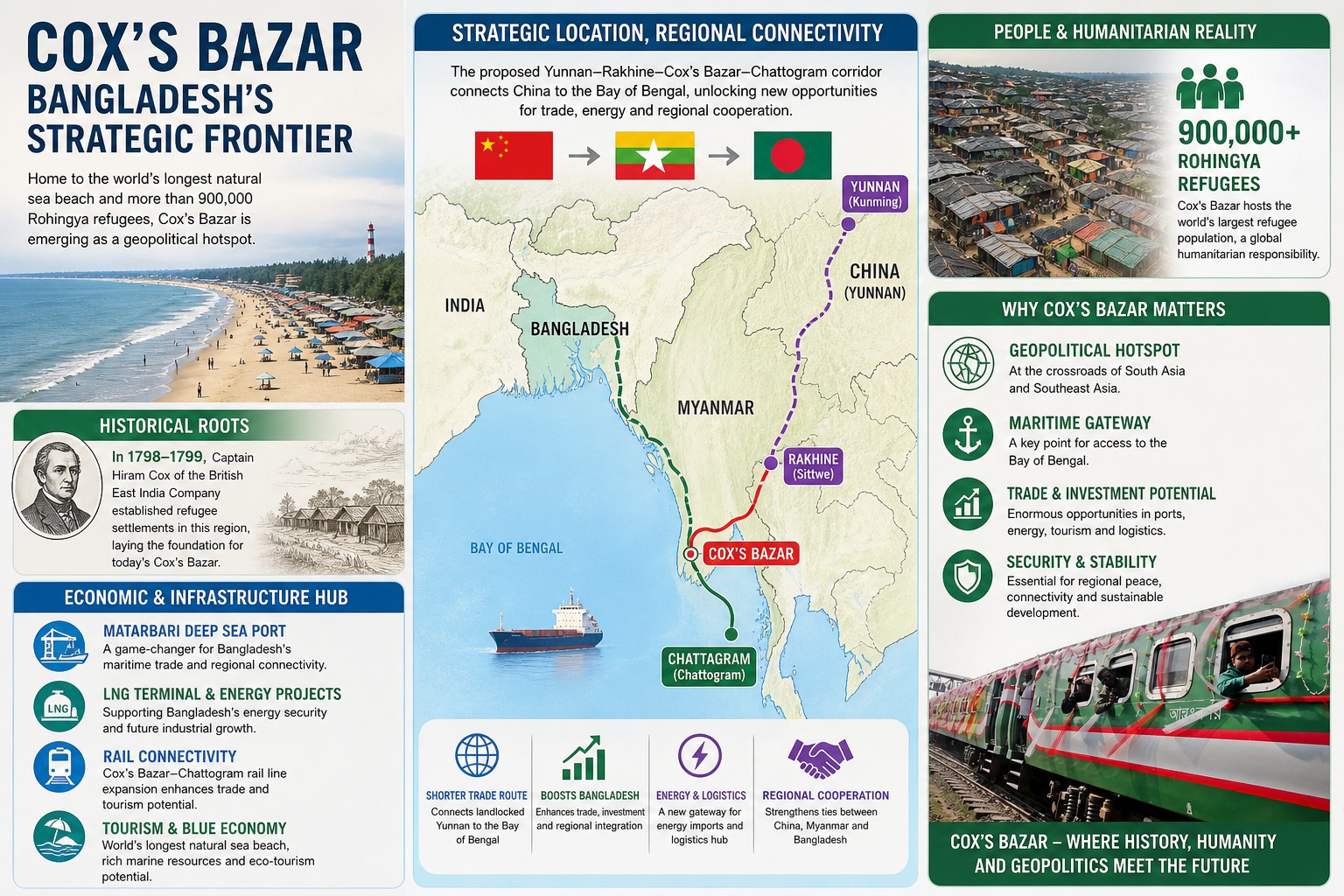
Known globally for the world's longest natural sea beach, Cox's Bazar is increasingly becoming far more than a tourism destination. The district has emerged as one of Bangladesh's most strategically significant regions, where regional power competition, refugee management, maritime security and major infrastructure projects are converging to reshape its geopolitical importance.
Bordering Myanmar and overlooking the Bay of Bengal, Cox's Bazar now sits at the intersection of several competing regional interests. The Rohingya refugee crisis, cross-border human trafficking, narcotics smuggling, the development of Matarbari Deep Sea Port and Bangladesh's growing economic engagement with China have collectively transformed the coastal district into a strategic frontier in South Asia.
The discussion has gained renewed momentum following Prime Minister Tarique Rahman's recent visit to China. According to officials familiar with the matter, Beijing proposed a regional economic corridor linking Yunnan Province with Myanmar's Rakhine State before extending to Cox's Bazar and Chattogram through road and rail connectivity. If implemented, the corridor could become a significant component of regional trade and logistics.
The proposal reflects China's broader effort to diversify its access to the Indian Ocean. Beijing remains heavily dependent on the Malacca Strait for energy imports and international trade, while the strategic waterway is closely monitored by regional naval powers. A land corridor connecting China's southwest to the Bay of Bengal would offer an alternative route, enhancing the geopolitical importance of Bangladesh's southeastern coastline.
Cox's Bazar's strategic value is not new. The district traces its modern history to Captain Hiram Cox, an official of the British East India Company who settled Arakanese refugees in the area at the end of the 18th century. His resettlement programme also served broader colonial objectives, including frontier security, agricultural expansion and strengthening British influence along the eastern border. More than two centuries later, many of those same themes—migration, border management and security—continue to define the district's importance.
The region's economic significance has also grown rapidly over the past decade. The Maheshkhali-Matarbari area is home to large-scale energy projects, liquefied natural gas infrastructure, a deep-sea port and economic zones designed to support Bangladesh's industrial expansion. The extension of the Dhaka-Cox's Bazar railway and the expansion of Cox's Bazar Airport are expected to improve domestic and international connectivity, strengthening the district's role as a commercial gateway.
Meanwhile, St Martin's Island continues to attract political attention. Previous claims by the former Awami League government that foreign powers had sought access to the island were firmly rejected by the United States, but the debate underscored the growing sensitivity surrounding Bangladesh's maritime territory amid wider geopolitical competition in the Bay of Bengal.
Despite its economic potential, Cox's Bazar continues to face complex security and humanitarian challenges. The district hosts the world's largest refugee settlement, where more than 900,000 Rohingya refugees remain displaced after fleeing violence in Myanmar. Human trafficking networks, drug smuggling and cross-border crime continue to place pressure on local authorities and security agencies.
Analysts argue that the district's future will depend on balancing development with national security. If managed effectively, Cox's Bazar could evolve beyond its identity as a tourism hub to become a regional centre for blue economy development, maritime trade and strategic connectivity. As regional competition intensifies across the Bay of Bengal, decisions taken in Cox's Bazar are increasingly likely to shape not only Bangladesh's economic future but also its broader geopolitical position in the Indo-Pacific.