
Downpour of Asharh: Relieving Rain Turns into Megacity’s Nightmare
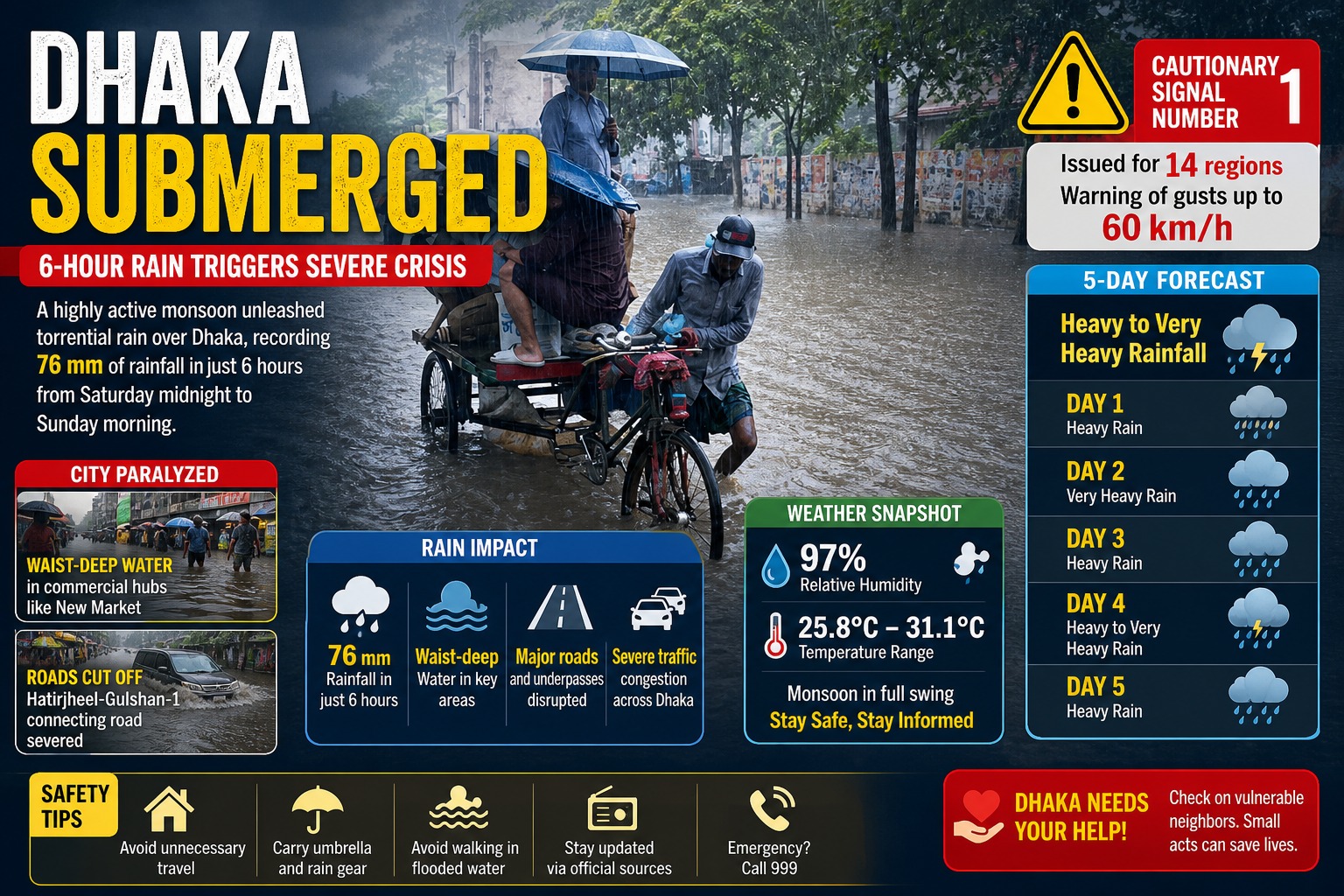
The calendar marks Asharh—the traditional, familiar monsoon of Bengal. Dense clouds gather across the sky following nature's law, drenching both villages and cities in an incessant downpour. This heavy rainfall brings immense relief to a thirsty nature at times, yet it unleashes severe misery upon public life at others. Rain should arrive as a blessing for urban life; instead, unplanned urbanization and flawed drainage systems transform it into a veritable curse. Recently, torrential rain throughout the night submerged Dhaka, the nation's primary megacity, once again. This precipitation continued through Sunday, leaving main roads and narrow alleys alike brimming with water.
The resulting severe waterlogging from this record rainfall inflicts extreme suffering upon ordinary city dwellers. Commuters, school-college students, and people heading out for urgent needs faced immense harassment on Sunday, the start of the workweek. Even emergency ambulances carrying patients failed to escape this terrible waterlogging, intensifying the crisis within the city's healthcare transportation.
A morning tour of various areas in the capital revealed an unprecedented, dismal sight. By 6:30 AM, water completely swallowed vital roads and inner lanes in Green Road, Tejturi Bazar, Panthapath, Bashundhara Residential Area, Monipur, Dhanmondi 27 and 32, Mohammadpur, Kalshi, Mouchak, Malibagh, and Motijheel. Dhaka New Market, a major commercial hub, accumulated waist-deep water, threatening to destroy goods in numerous shops. The intense pressure of the stagnant water broke a section of the connecting road between Hatirjheel and Gulshan-1, completely paralyzing vehicular movement. Ankle-deep to waist-deep water filled major thoroughfares and interior streets, preventing rickshaws, CNGs, and private cars from operating smoothly. Vehicles broke down in many places, triggering long traffic jams in the middle of the roads.
The situation reached such a terrifying state in a few areas that the boundary between roads and sidewalks vanished completely. Sheorapara exhibited the most critical and hazardous waterlogging. Pedestrians risked their lives walking through the area as the water hid open manholes and potholes on the sidewalks.
Despite repeated promises to build Dhaka into a beautiful city, the authorities fail to prevent this pathetic condition even during minor rain, fueling endless public anger. Local residents complain that this waterlogging represents a man-made crisis stemming from unplanned drainage rather than a natural disaster. The government spends millions of Taka year after year to clean drains and canals, yet the public reaps no actual benefit. Suffering citizens demand that the authorities immediately initiate effective, long-term measures to permanent end this recurring crisis.
Data from the Meteorological Department explains the reason behind this sudden waterlogging. According to their records, the capital received 76 millimeters of rainfall in just six hours, from Saturday midnight to Sunday morning. Dhaka’s existing drainage system lacks the capacity to handle such massive rainfall within a short span.
A formal forecast signed by meteorologist Md. Shahinul Islam stated that a highly active monsoon over the country might bring heavy to very heavy rainfall across various regions, including Dhaka, for a few more days. Similarly, squally winds, rain, and thundershowers might hit different parts of the country, prompting the department to advise river ports to hoist Cautionary Signal Number 1. Regions like Tangail, Mymensingh, Dhaka, Faridpur, Kushtia, Jessore, Khulna, Barisal, Patuakhali, Comilla, Noakhali, Chittagong, Cox's Bazar, and Sylhet might experience temporary gusts or storms blowing at 45 to 60 kilometers per hour from the south or south-east.
At 6:00 AM, Dhaka recorded a temperature of 26.2 degrees Celsius and a relative humidity of 97 percent. Although the capital recorded 28 millimeters of rain overall in the preceding 24 hours, the heavy downpour overnight complicated the situation. Yesterday, Dhaka saw a maximum temperature of 31.1 degrees Celsius, while today registered a minimum of 25.8 degrees Celsius.
The Bangladesh Meteorological Department announced that the active monsoon will maintain this trend of gusts, rain, and thundershowers across most parts of the country for the next five days. The forecast for the next 24 hours predicts light to moderate rain or thundershowers across most places in Rajshahi, Dhaka, Barisal, and Chittagong divisions, with possibilities of moderately heavy to very heavy falls in certain locations. Consequently, experts fear a prolonged waterlogging situation in Dhaka.
Rain signals a blessing from nature, yet it evokes pure terror in Dhaka. Lack of coordination among WASA and the two city corporations, combined with the illegal occupation of canals, creates this core problem. Dhaka residents will continue to endure this suffering every monsoon unless the authorities modernize the drainage system, reclaim canals and water bodies, and install modern pumps for rapid water evacuation. The authorities must act immediately.