
Beyond Bilateral Diplomacy
Why a Stronger Dhaka–Washington Partnership Could Redefine South Asia’s Strategic Future
International diplomacy is entering one of its most consequential periods since the end of the Cold War. The international order is no longer defined by a single dominant power or a rigid bipolar rivalry. Instead, geopolitical competition, economic interdependence, technological transformation, climate challenges and strategic connectivity are collectively reshaping global affairs. In this evolving landscape, middle powers are becoming increasingly influential, and Bangladesh is steadily emerging as one of them.
Once viewed primarily through the lens of development assistance and labour-intensive manufacturing, Bangladesh is now attracting international attention as a strategically important economic and geopolitical partner. Its location at the crossroads of South and Southeast Asia, access to the Bay of Bengal, expanding economy, young workforce and growing diplomatic profile have significantly elevated its importance within the wider Indo-Pacific.
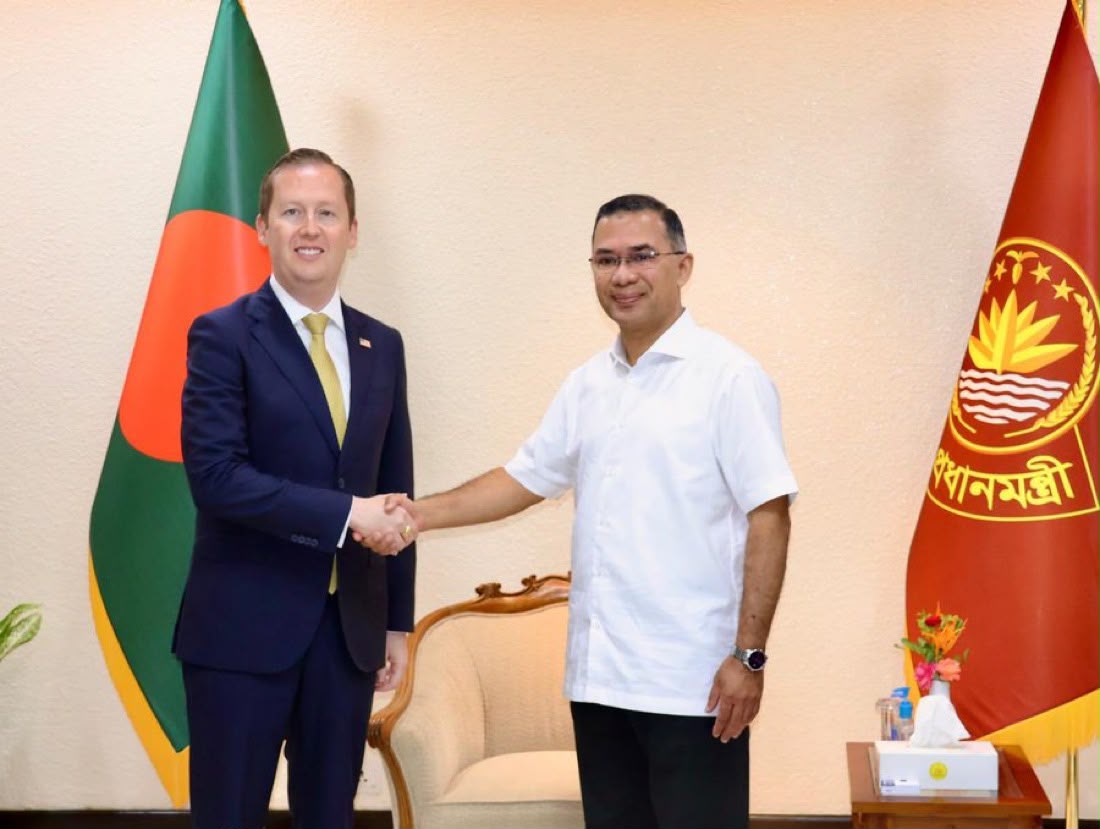
Recent diplomatic engagement between Dhaka and Washington illustrates this changing reality. The visit of Sergio Gor, US President Donald Trump’s Special Envoy for South and Central Asia, to Bangladesh attracted considerable attention not merely because of the personalities involved but because of what it suggested about the evolving priorities of both governments.
During his visit, Sergio Gor held discussions with Prime Minister Tarique Rahman at the Prime Minister’s Office. According to official statements released after the meeting by the Prime Minister’s Office and the Ministry of Foreign Affairs, the discussions covered a broad spectrum of bilateral and regional issues, including trade, investment, economic cooperation, regional security and strategic partnership. Gor’s public comments and messages shared through his official X account further reinforced the impression that Washington sees Bangladesh as an increasingly important partner in South Asia, particularly from an economic and investment perspective.
While every diplomatic visit generates political commentary and competing interpretations, diplomacy is ultimately judged not by speculation but by continuity, substance and outcomes. The significance of the visit therefore lies less in domestic political debate than in the broader trajectory of Bangladesh-United States relations.
One theme appears particularly noteworthy. Official messaging following the discussions suggested a strong emphasis on creating an even more favourable environment for American investment in Bangladesh. If that direction continues, it represents more than an ordinary expansion of bilateral trade. It signals growing confidence in Bangladesh’s long-term economic prospects and its strategic role within emerging global supply chains.
This development comes at a time when the United States and many advanced economies are actively diversifying investment destinations. The disruptions caused by the pandemic, geopolitical tensions and supply-chain vulnerabilities have encouraged governments and multinational corporations to reduce excessive dependence on single production centres. Countries offering political stability, competitive manufacturing, improving infrastructure and favourable demographics have naturally become more attractive.
Bangladesh fits many of these criteria. It has maintained impressive economic growth over the past decade, developed globally competitive manufacturing industries, expanded physical infrastructure and invested heavily in digital connectivity. Its graduation from the Least Developed Country category also marks a transition toward a more diversified and sophisticated economic model.
For Washington, Bangladesh’s importance extends well beyond commerce. The Indo-Pacific has become the principal arena of twenty-first century geopolitics. Maritime security, resilient supply chains, digital infrastructure, energy security, advanced technology and regional connectivity increasingly overlap within this strategic space. Bangladesh’s position on the Bay of Bengal gives it significance that extends far beyond its national borders.
At the same time, Bangladesh has pursued a foreign policy that emphasizes strategic balance rather than exclusive alignment. It has strengthened economic relations with the United States while maintaining important partnerships with China, India, Japan, the European Union, Gulf countries and ASEAN members. This multidimensional diplomacy reflects a pragmatic understanding that sustainable national development requires diversified international engagement.
Such an approach is particularly relevant in today’s multipolar world. Smaller and medium-sized countries are no longer compelled to choose between competing global powers in the simplistic terms that characterized earlier eras. Instead, they increasingly seek cooperation wherever mutual interests exist while preserving strategic autonomy.
This balanced strategy also serves South Asia’s broader interests. The region remains home to nearly one-quarter of the world’s population but continues to lag behind other regions in economic integration. Political tensions, infrastructure deficits and limited cross-border connectivity have constrained growth despite enormous potential.
Bangladesh has an opportunity to become one of the region’s principal connectivity hubs. Investments in ports, logistics, highways, railways, digital infrastructure and energy corridors could transform the Bay of Bengal into one of Asia’s most dynamic economic zones. Such progress would benefit not only Bangladesh but also India, Nepal, Bhutan, Sri Lanka and, increasingly, Southeast Asian economies.
Economic diplomacy therefore deserves to remain at the centre of Bangladesh’s foreign policy. As the country prepares for post-LDC competitiveness, attracting high-quality foreign direct investment will become increasingly important. Investment from technologically advanced economies can contribute not only capital but also innovation, managerial expertise, research collaboration and integration into global value chains.
Technology represents another area where bilateral cooperation could expand significantly. Artificial intelligence, semiconductors, cybersecurity, biotechnology, fintech and advanced manufacturing are rapidly redefining international competitiveness. Bangladesh possesses one of South Asia’s youngest labour forces, creating enormous opportunities if education, skills development and international technology partnerships advance together.
Climate diplomacy also provides common ground. Bangladesh remains among the countries most vulnerable to climate change despite contributing relatively little to global greenhouse gas emissions. Cooperation with advanced economies on renewable energy, climate finance, green technology and resilience infrastructure would produce benefits extending well beyond bilateral relations.
Security cooperation is evolving as well. Maritime governance, cyber resilience, disaster preparedness, counterterrorism and humanitarian assistance increasingly require coordinated international responses. Constructive engagement in these areas strengthens regional stability without necessarily implying military alignment or strategic confrontation.
Equally significant is Bangladesh’s expanding role in multilateral diplomacy. Active participation in the United Nations and other international institutions allows Bangladesh to contribute to debates on sustainable development, migration, peacekeeping, climate justice and global governance reform. A confident bilateral relationship with major partners complements rather than replaces effective multilateral engagement.
Of course, international diplomacy today unfolds under the constant scrutiny of social media and twenty-four-hour news cycles. Rumours, speculation and politically motivated narratives often travel faster than official diplomacy itself. Every high-level meeting quickly becomes the subject of competing interpretations.
Yet successful foreign policy cannot be measured by the intensity of political speculation. It must instead be assessed through institutional continuity, expanding economic cooperation, increasing investor confidence, regular strategic dialogue and measurable national outcomes.
If the signals emerging from the recent Dhaka discussions translate into sustained investment, expanded commercial partnerships and deeper institutional cooperation, they may mark the beginning of a more consequential phase in Bangladesh-United States relations.
The implications extend beyond the bilateral relationship. A stronger economic partnership between Dhaka and Washington has the potential to contribute to broader regional stability, diversified supply chains, greater investor confidence and enhanced economic integration throughout South Asia. In an increasingly fragmented global economy, partnerships built around mutual benefit rather than geopolitical confrontation are likely to prove more durable.
Bangladesh’s greatest diplomatic strength lies in its ability to engage constructively with multiple centres of global influence while consistently prioritising national interests. That strategic flexibility has become one of its most valuable foreign policy assets.
Ultimately, the measure of diplomacy is not the number of official visits, nor the volume of political commentary they generate. It is the quality of partnerships that emerge, the opportunities they create for citizens, the confidence they inspire among investors and the contribution they make to regional peace and prosperity.
If Bangladesh continues to strengthen relations with the United States while preserving productive engagement with its other major partners, it will reinforce its position as one of the Indo-Pacific’s most consequential middle powers. The recent visit by Sergio Gor may therefore be remembered not simply as another diplomatic engagement, but as part of a broader strategic transition one in which Dhaka is increasingly recognised not merely as an emerging economy, but as an indispensable partner in shaping the economic and geopolitical future of South Asia.
(Writer Shahidul Alam Swapan is a Swiss-based private banking financial crime specialist, columnist, and poet writing on governance, democracy, financial integrity, and international affairs. He could be reached at: shahidul.alam@bluewin.ch)