
Malaysia Signals Fresh Push to Reopen Labour Market for Bangladeshi Workers
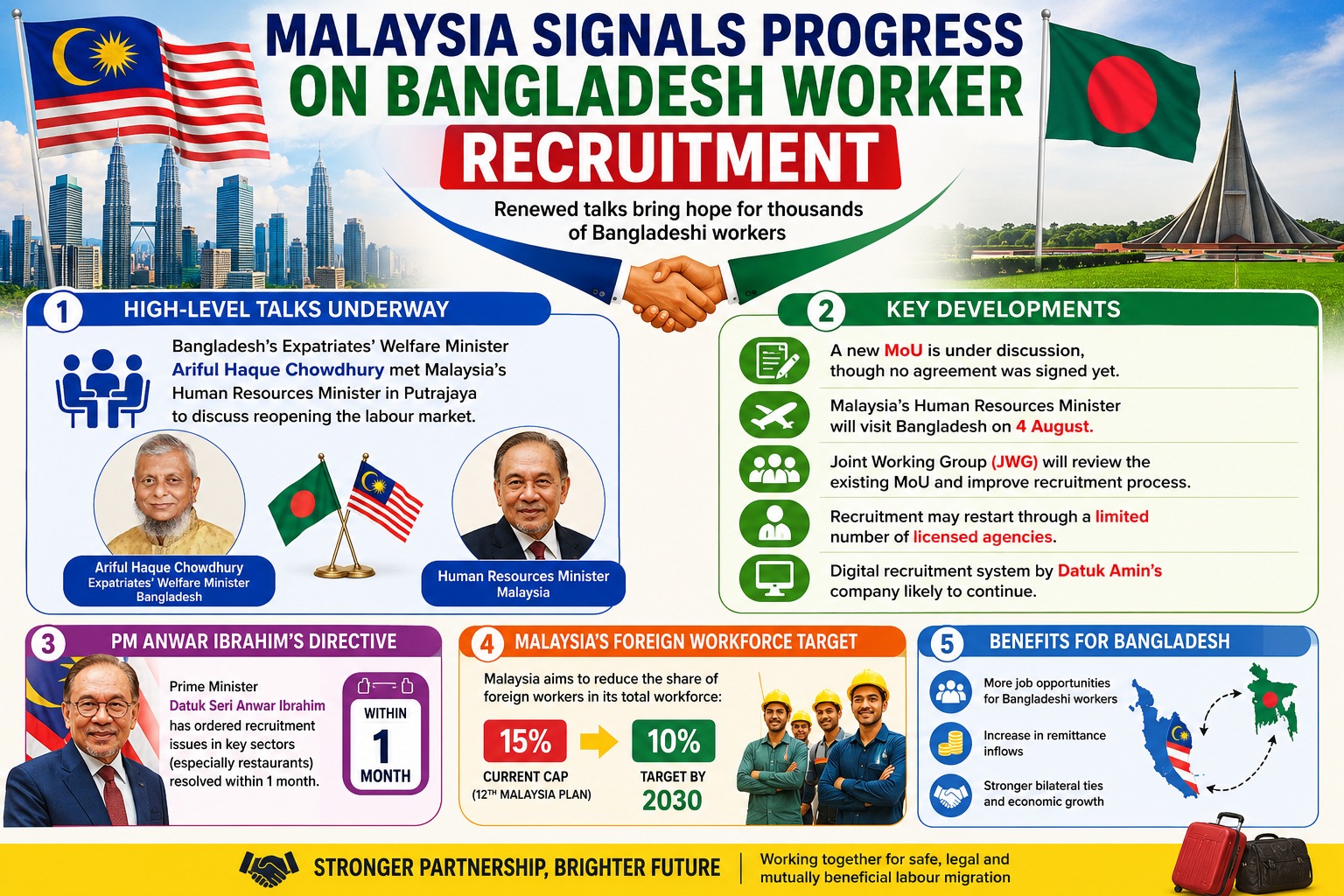
Bangladesh and Malaysia have taken a fresh step toward reopening one of South Asia's most important labour migration corridors, as senior officials from both countries meet to explore a new framework for recruiting Bangladeshi workers after more than two years of uncertainty.
Bangladesh's Minister for Expatriates' Welfare and Overseas Employment, Ariful Haque Chowdhury, travelled to Malaysia on Monday night for high-level talks with Malaysia's Human Resources Minister in Putrajaya this week. The meeting is expected to focus on reviving worker recruitment, reviewing existing arrangements and identifying a more transparent mechanism for future labour migration.
Officials familiar with the discussions said the two governments are not expected to sign a new memorandum of understanding (MoU) immediately. Instead, negotiations are likely to concentrate on refining the draft of a future agreement, a process that could require several more rounds of consultations before a formal deal is concluded.
Despite the absence of an immediate agreement, the talks have raised expectations that Malaysia may resume recruiting Bangladeshi workers through a limited number of licensed recruitment agencies while broader reforms are negotiated.
The latest diplomatic engagement follows discussions during Prime Minister Tarique Rahman's recent visit to Malaysia, where both governments agreed that the Joint Working Group (JWG) would evaluate the existing labour recruitment framework. The group has been tasked with examining the effectiveness and shortcomings of the current MoU and recommending reforms aimed at ensuring safe, orderly and mutually beneficial labour migration.
The review is also expected to address concerns over transparency in recruitment procedures, an issue that has repeatedly overshadowed Bangladesh-Malaysia labour cooperation in recent years.
Another round of negotiations is expected next week when Malaysia's Human Resources Minister is scheduled to visit Bangladesh on 4 August with a government delegation. Officials from both countries are expected to discuss changing labour market requirements, migration governance and future recruitment procedures.
However, questions remain over whether the recruitment process will genuinely become more competitive. Industry sources in Malaysia said the digital recruitment platform developed by Datuk Amin, a key figure associated with the previous recruitment syndicate involving workers from 15 source countries, is likely to continue operating. His company has reportedly secured responsibility again under Malaysia's latest tender process, raising concerns among labour market observers that the same dominant recruitment structure could remain in place despite promises of reform.
The renewed optimism also follows recent comments by Malaysian Prime Minister Datuk Seri Anwar Ibrahim, who instructed relevant ministries to resolve applications related to foreign worker recruitment within one month, particularly in sectors facing acute labour shortages such as restaurants.
Speaking in Butterworth, Penang, at the launch of the Indian Muslim Transformational Framework (IMTF) 2030, Anwar acknowledged severe workforce shortages in selected industries but stressed that foreign worker recruitment must remain controlled and well managed. He emphasised that Malaysia does not intend to reopen its labour market indiscriminately for low-skilled foreign workers, but rather to address urgent shortages in sectors where employers face significant difficulties in hiring.
Malaysia's Communications Minister and government spokesperson Datuk Seri Fahmi Fadzil has also confirmed that the cabinet is reassessing the need for foreign workers in sectors including restaurants and construction following industry requests.
Malaysia currently maintains strict limits on foreign labour. Under the 12th Malaysia Plan, foreign workers cannot exceed 15% of the country's total workforce, while the 13th Malaysia Plan aims to reduce that proportion further to 10% by 2030.
For Bangladesh, whose overseas employment sector relies heavily on labour migration, the combination of high-level bilateral engagement, policy reviews and Malaysia's growing labour shortages has generated cautious optimism. While a final agreement remains some distance away, the diplomatic momentum suggests that a long-stalled labour market could gradually reopen—provided both governments can overcome longstanding concerns over governance, transparency and recruitment practices.