
No formal communication with Bangladesh yet; proposal still under discussion in the European Parliament
Five EU States Plan 'Return Hubs' That Could Affect Bangladeshi Asylum Seekers
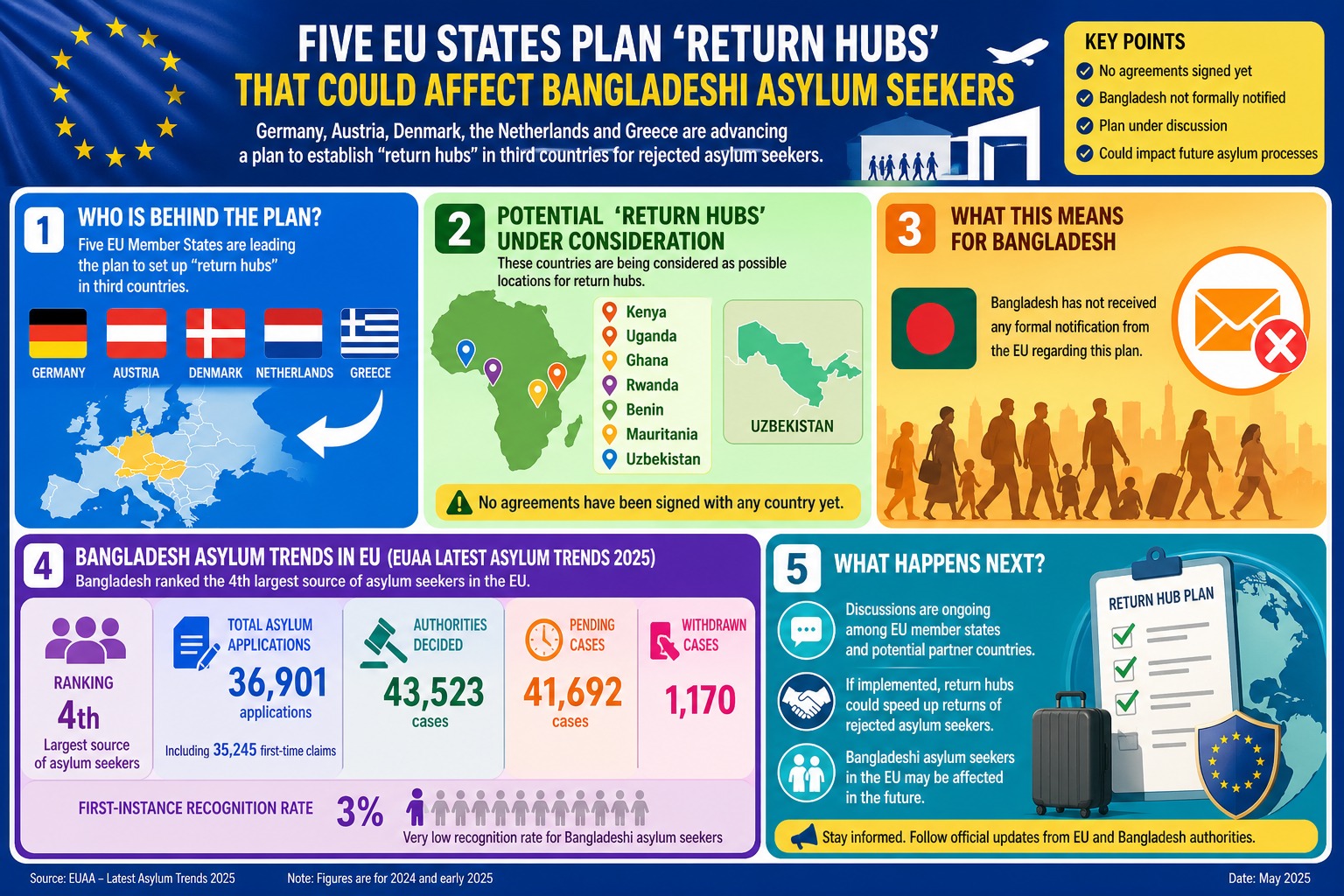
A group of five European countries—Germany, Austria, Denmark, the Netherlands and Greece—is jointly advancing a plan to establish "return hubs" outside the European Union, a move that could affect Bangladeshi asylum seekers whose applications are ultimately rejected.
Under the proposal, asylum seekers from Bangladesh and other countries whose claims are finally denied would be transferred temporarily to designated third countries before being repatriated to their home countries. Kenya, Uganda, Ghana, Rwanda, Benin, Mauritania and Uzbekistan are among the countries being considered as potential hosts. However, no formal agreement has yet been signed with any of them.
Greece has recently taken a leading role in promoting the initiative. According to the country's migration ministry, the five participating states hope to conclude agreements with host countries later this year, allowing the return hub system to become operational next year.
The initiative is based on the European Commission's proposed Return Regulation, which would permit EU member states, under certain conditions, to establish return hubs outside the bloc. The centres would temporarily accommodate migrants whose asylum applications have been conclusively rejected but who cannot immediately be returned to their countries of origin. Repatriation would be completed later in coordination with the relevant governments.
Officials at Bangladesh's Ministry of Foreign Affairs said the government has not yet received any formal notification from the five European countries regarding the proposal. They noted that the plan remains at the policy stage and is still being debated in the European Parliament, with differences of opinion among EU member states.
A senior foreign ministry official, speaking on condition of anonymity, said the proposal is not aimed specifically at Bangladesh but would apply to nationals of any country whose asylum applications are rejected. The official noted that Bangladeshi nationals could nevertheless be significantly affected because of the country's low asylum approval rate in Europe.
"The first-instance recognition rate for Bangladeshi asylum seekers is only around 3-4 percent," the official said. "Although the return hub mechanism has not yet been finalised, the proposed regulation seeks to accelerate asylum decisions and deportation procedures. New applications could be processed within approximately 12 weeks."
The proposal has drawn criticism from human rights organisations and European institutions. The Council of Europe's Commissioner for Human Rights has urged participating governments to fully comply with international refugee law, the European Convention on Human Rights and the principle of non-refoulement. Rights groups argue that processing rejected asylum seekers in third countries could weaken access to legal protection and judicial remedies.
According to the European Union Agency for Asylum (EUAA) in its Latest Asylum Trends 2025 report, Bangladesh ranked as the fourth-largest source country of asylum applicants in the EU after Syria, Venezuela and Afghanistan.
The report says 36,901 asylum applications were lodged by Bangladeshi nationals in 2025, including 35,245 first-time applications. During the year, EU authorities issued first-instance decisions on 43,523 Bangladeshi applications, while 41,692 cases remained pending at year-end. Another 1,170 applications were withdrawn. The first-instance recognition rate for Bangladeshi applicants stood at just 3 percent.
Expatriates' Welfare and Overseas Employment State Minister Md Nurul Haque said Bangladesh has not received any official communication on the proposed return hub initiative. He also argued that there is no current justification for Bangladeshi citizens to seek political asylum abroad, saying the country now has a democratically elected government and constitutional rights are being upheld.