
Bangladesh Climate Aid Project Faces Scrutiny as Consultancy Costs Dwarf Support for Displaced Families
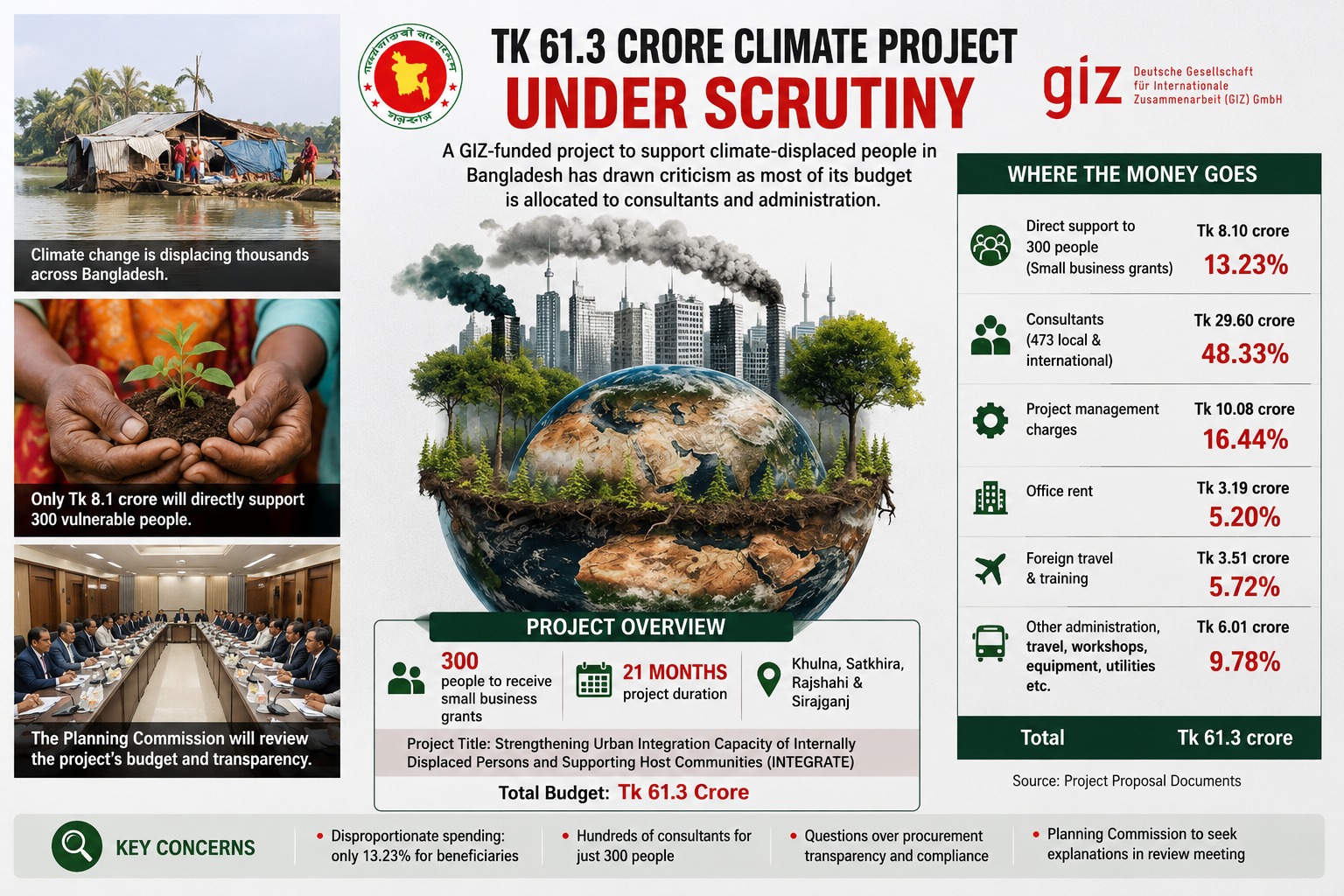
A Bangladesh government proposal designed to support people displaced by climate change has come under scrutiny after official documents showed that only a small share of its budget would directly benefit vulnerable families, while most of the funding is earmarked for consultants, administration and project management.
According to project documents scheduled for review by the Planning Commission's Project Evaluation Committee (PEC), the proposed Tk 61.3 crore project would allocate only Tk 8.1 crore (13.23%) as direct financial assistance for 300 climate-displaced people through small business grants. More than Tk 53.18 crore would instead be spent on consultancy services, management, office operations, travel and other administrative costs.
The project, titled "Strengthening Urban Integration Capacity of Internally Displaced Persons and Supporting Host Communities (INTEGRATE)," has been proposed by the Department of Social Services and is expected to be financed by the German development agency GIZ over a 21-month period.
The initiative aims to improve livelihoods in Khulna, Satkhira, Rajshahi and Sirajganj, benefiting 300 direct recipients while supporting around 1,500 people through broader livelihood programmes. However, budget allocations have raised concerns over whether resources are being directed toward beneficiaries or project administration.
Documents show the project plans to recruit 473 domestic and international consultants, with consultancy fees alone estimated at Tk 29.6 crore, accounting for nearly 48.3% of the total budget. By contrast, direct grants for vulnerable households amount to only Tk 8.1 crore.
The proposal also includes Tk 10.08 crore for project management, Tk 3.19 crore for office rent, Tk 3.51 crore for overseas travel and training, and Tk 1.28 crore for domestic travel. Additional allocations cover workshops, transport, utilities, telecommunications equipment and IT procurement.
Planning Commission officials are expected to question the high consultancy and administrative expenses during Sunday's PEC meeting. Officials reviewing the proposal have also expressed concerns about the lack of transparency in selecting beneficiaries and possible shortcomings in compliance with Bangladesh's Public Procurement Act (2006) and Public Procurement Rules (2008).
A Planning Commission official, speaking on condition of anonymity, said the project's primary objective should be improving the livelihoods of climate-displaced communities rather than financing administrative structures. Officials are expected to seek explanations for the large consultancy budget and determine whether several expenditure items should be reduced before approval.
The Department of Social Services has defended the proposal, arguing that it is a technical assistance project prepared largely according to donor requirements. Md Sajjadul Islam, Director of Planning and Development, said the proposal was developed by GIZ through the Economic Relations Division (ERD), leaving limited scope for changes. He added that overseas travel would only take place if approved by the government.
Development analysts warn that unless the spending structure is significantly revised, the project risks undermining its stated objective of supporting climate-vulnerable communities, with administrative costs overshadowing direct assistance for those it is intended to help.