
Cambodia-Thailand Route Fuels Human Trafficking
The journey often begins with a promise: a well-paid job, quick visa processing and the prospect of a better life abroad. For hundreds of young Bangladeshis, however, that promise ends in prison cells, online scam compounds or remote border camps across Cambodia and Thailand.
What was once viewed as a convenient migration route has increasingly become one of Southeast Asia's most dangerous human trafficking corridors. Human traffickers are exploiting the relatively accessible visa regimes of Cambodia and Thailand to recruit Bangladeshis, only to force many into cyber fraud operations, online scams and exploitative labour after they arrive.
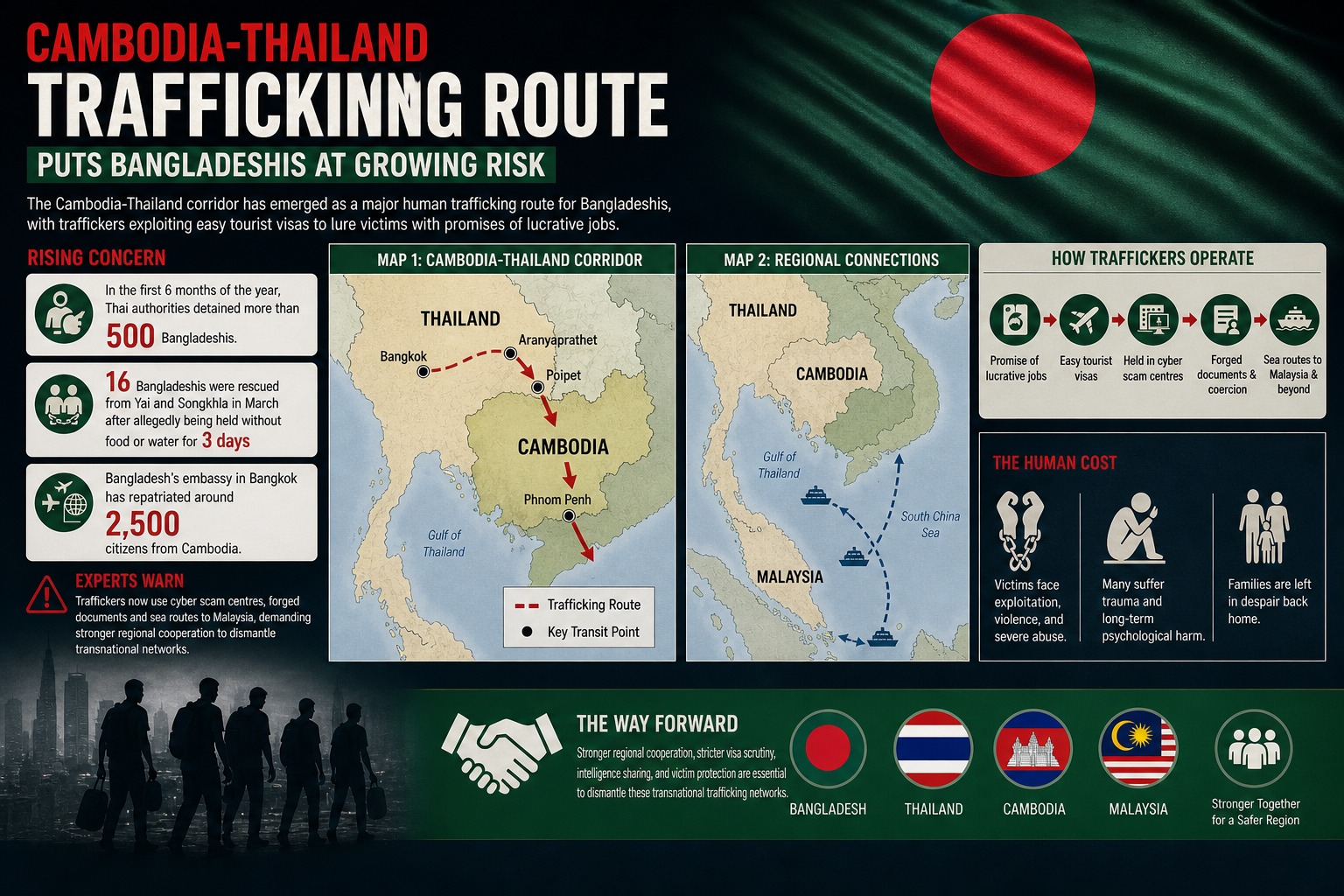
According to officials and migration experts, victims are usually taken to Cambodia or Thailand on tourist visas before being moved through remote border crossings or by sea to Malaysia, Laos and other countries in the region. Many lose contact with their families, while others disappear entirely.
The scale of the crisis is becoming more visible. During the first six months of this year alone, Thai authorities detained more than 500 Bangladeshi nationals for immigration-related offences. In March, Thai police rescued 16 Bangladeshis from Yai and Songkhla after traffickers allegedly kept them without food or water for three days. Their condition highlighted the brutality that often accompanies these trafficking networks.
Bangladesh's embassy in Bangkok is struggling to respond. With no Bangladeshi embassy in Cambodia, the mission in Thailand has been tasked with visiting prisons, issuing emergency travel documents and negotiating the release and repatriation of detainees across both countries. Officials acknowledge that limited manpower has made the work increasingly difficult, while thousands of Bangladeshis are believed to remain in detention or stranded in different parts of Cambodia and Thailand.
Migration specialist Asif Munir, a former official of the International Organization for Migration (IOM), says traffickers have adapted quickly to changing migration patterns. They lure young people with promises of high salaries and low migration costs before trapping them in criminal enterprises. Their operations stretch across borders, making enforcement difficult without intelligence sharing and coordinated regional action.
Diplomatic sources say many Bangladeshis were recruited to work in Cambodia's notorious scam centres and casino compounds through fraudulent visas and fake job offers. As Cambodian authorities have intensified crackdowns on these facilities, many workers have lost their livelihoods. Trafficking groups are now exploiting their vulnerability by offering illegal onward journeys to Malaysia and neighbouring countries. The Bangladesh mission has already facilitated the return of around 2,500 citizens from Cambodia by issuing emergency travel passes.
Bangladesh's Counter Terrorism and Transnational Crime (CTTC) unit recently arrested Mahafuz Ullah Siddiqui, identified by investigators as one of the alleged masterminds behind a trafficking network operating through Cambodia. Police say legal proceedings are underway.
Experts argue that human trafficking has evolved into a sophisticated transnational business driven by digital recruitment, forged documents and social media advertising. Combating it requires more than arrests. Stronger regional cooperation, closer intelligence sharing and tighter oversight of recruitment and travel agencies are essential. Equally important is raising public awareness so that offers of lucrative overseas jobs are met with caution rather than desperation.
For many Bangladeshis seeking a way out of poverty, the road through Cambodia and Thailand still appears to lead towards opportunity. Too often, it leads somewhere far darker.