
Bangladesh's Poultry Industry Nears Breaking Point as Production Costs Double in Five Years
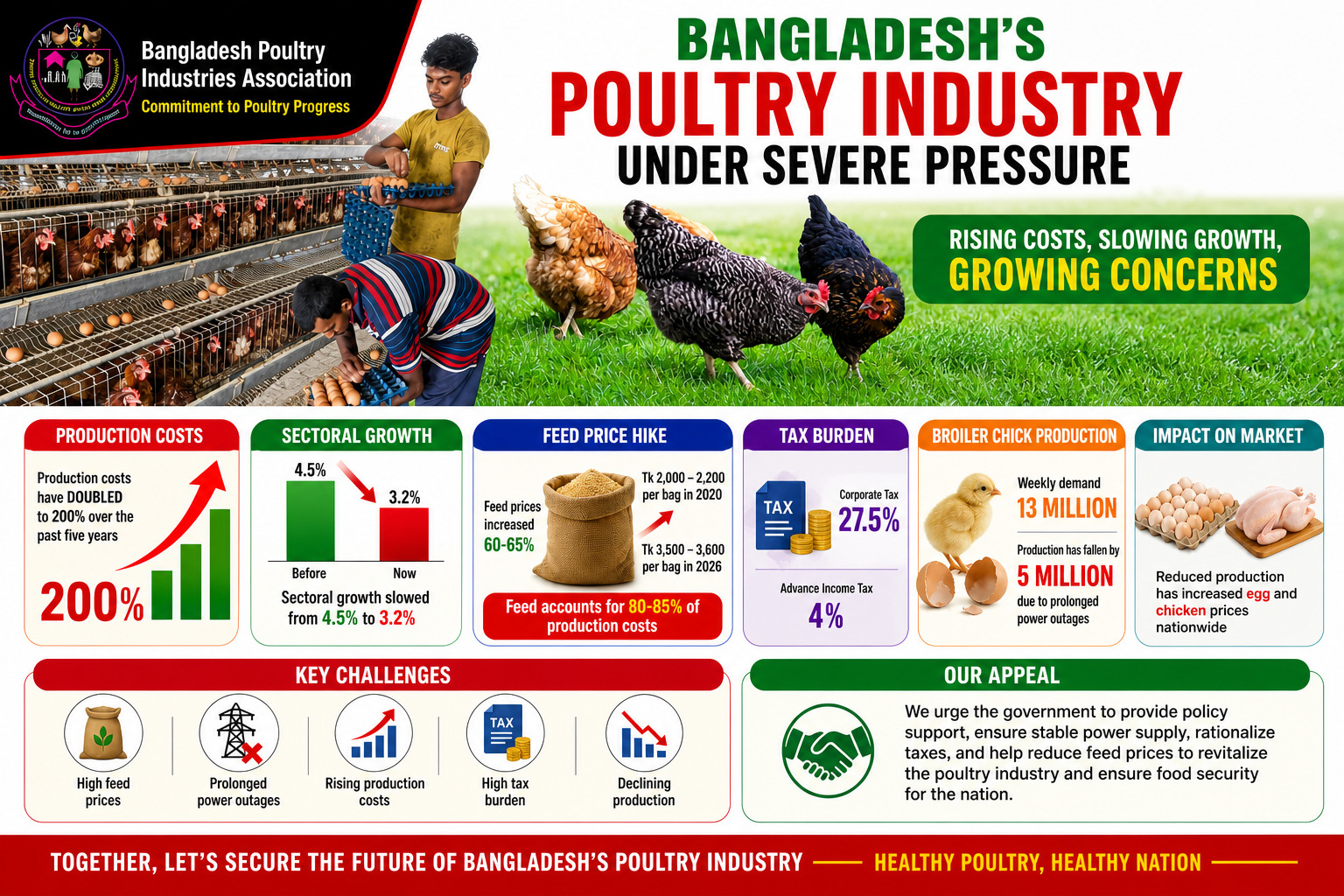
Bangladesh's poultry industry is facing one of its worst crises in recent years as production costs have more than doubled over the past five years, squeezing thousands of small and medium-sized farmers and driving up the prices of eggs and chicken in the domestic market.
Industry stakeholders say soaring feed prices, disease outbreaks, rising fuel and transportation costs, prolonged power outages, and increased taxes have combined to threaten the sustainability of one of the country's largest ago-based industries.
According to the Bangladesh Poultry Industries Association (BPIA), the sector's annual growth has slowed from 4.5% to 3.2%, while production costs that previously stood at Tk 100 have now risen to Tk 210 or more.
Feed remains the industry's biggest expense, accounting for 80-85% of total production costs. Poultry farmers say feed prices have risen dramatically, while the current fiscal year's higher corporate tax, Advance Income Tax (AIT), and turnover tax have added further financial pressure.
Farmer Aminul Pradhan from Faridpur said his farm once produced 10,000 eggs daily, but persistent losses forced him to shut down half of his poultry sheds. Veteran poultry entrepreneur Alamgir Hossain, who has been in the business for more than two decades, said producing an egg now costs nearly Tk 10, yet wholesale prices often fall to Tk 8, making sustained operations impossible. Many farmers around him have already abandoned the business.
BPIA President Mosharraf Hossain Chowdhury urged the government to abolish the country's 4% Advance Income Tax, noting that many competing countries impose no such tax on poultry producers. He also criticized Bangladesh's 27.5% corporate tax, compared with 12-15% in neighboring countries, calling for immediate tax reductions to restore competitiveness.
Feed prices have surged by 60-65% since 2020. A sack of poultry feed that cost Tk 2,000-2,200 in 2020 now sells for Tk 3,500-3,600 in 2026. Meanwhile, wholesale egg prices have increased by only 20-25%, from Tk 6-7 per egg to Tk 8-9, leaving farmers unable to recover their rising production costs.
Power shortages have further intensified the crisis. Poultry farming requires uninterrupted electricity to maintain proper temperatures for hatcheries, incubators, and broiler production. However, farmers report daily power outages lasting 8-12 hours, with some areas experiencing up to 20 hours of load shedding. As a result, farms have become increasingly dependent on diesel-powered generators, but record-high fuel prices have significantly increased operating expenses.
According to the Breeders Association of Bangladesh (BAB), the country requires approximately 13 million broiler chicks every week, yet production has fallen by nearly 5 million chicks weekly because incubators cannot maintain stable temperatures during prolonged outages. The association's General Secretary Shah Fahad Habib said higher diesel costs alone have increased production costs by Tk 2-3 per chick and Tk 0.25-0.50 per egg.
The sector has also been hit by disease outbreaks, including avian influenza, Newcastle disease, and cholera, which have reduced poultry populations and discouraged many farmers from restarting production.
Industry data show production costs have climbed steadily over recent years—115% in 2022, 145% in 2023, 170% in 2024, 190% in 2025, and 200% in 2026—effectively doubling within five years.
Transportation costs have also risen sharply following fuel price increases. Business leaders estimate logistics expenses have jumped by nearly 20% in just the past two weeks, while lower production volumes have reduced truck utilization and increased per-unit delivery costs.
According to the Bangladesh Breeders Association, the country normally produces around 25 million Sonali and colored chicks every week, but market supply has recently fallen to 15-20 million, reflecting the industry's mounting challenges.
Industry leaders warn that unless taxes and duties are reduced, electricity supply improves, and disease control measures are strengthened, thousands of small and medium-sized poultry farms may be forced out of business. They caution that continued financial pressure could eventually leave Bangladesh's poultry sector dominated by a handful of large corporate producers, reducing competition and ultimately driving food prices even higher for consumers