
Financial Crime in Focus: The Circuit Breaker
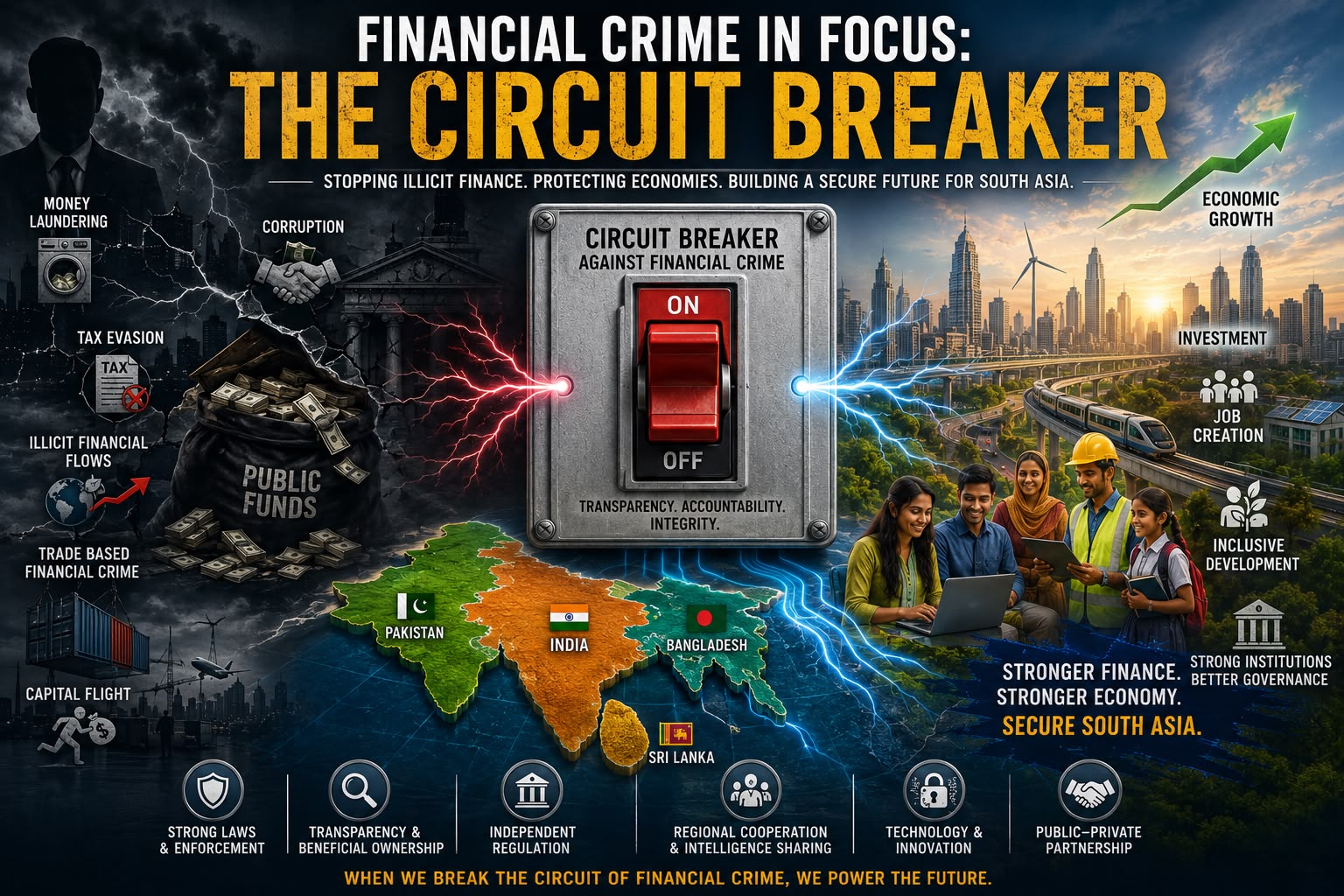
Financial crime rarely begins with dramatic headlines. It starts quietly with a shell company, a forged invoice, an unexplained bank transfer, or a politically connected individual moving illicit wealth beyond national borders. Yet the cumulative impact is devastating. It weakens public institutions, distorts markets, discourages investment, and ultimately slows economic development. For South Asia, where governments are striving to accelerate industrialisation, attract foreign investment, and reduce poverty, combating financial crime has become more than a law enforcement challenge; it is an economic necessity.
The concept of a “circuit breaker” is borrowed from financial markets, where trading is temporarily halted to prevent panic and restore order. In the fight against financial crime, effective anti-money laundering (AML), counter-terrorist financing (CTF), and anti-corruption measures serve a similar function. They interrupt the flow of illicit finance before it spreads through the economy, undermines confidence, and fuels broader instability.
South Asia has emerged as one of the world’s fastest-growing regions, yet it continues to face significant governance challenges. The region’s expanding trade, digital banking, remittance flows, and infrastructure investment have created enormous opportunities. At the same time, they have also increased vulnerabilities to money laundering, corruption, tax evasion, trade-based financial crime, cyber fraud, and the financing of organised criminal networks.
Financial crime is not simply about stolen money. Every dollar diverted through corruption represents a hospital left unfinished, a school inadequately funded, or infrastructure delivered at inflated costs. Investors, both domestic and international, carefully assess governance standards before committing long-term capital. Countries perceived as having weak financial integrity often face higher borrowing costs, lower foreign direct investment, and increased scrutiny from global financial institutions.
Bangladesh offers both a warning and an opportunity. Over the past decade, the country has demonstrated remarkable economic resilience through sustained export growth, strong remittance inflows, and expanding manufacturing capacity. However, concerns over loan defaults, illicit financial flows, procurement irregularities, and capital flight continue to raise important questions about institutional accountability. While regulatory agencies have strengthened compliance frameworks and financial intelligence capabilities, enforcement remains uneven. Sustainable economic progress will ultimately depend not only on growth statistics but also on public confidence in the integrity of financial institutions.
Neighbouring countries illustrate similar lessons. India has significantly expanded its digital financial infrastructure and strengthened financial intelligence mechanisms, yet continues to battle large-scale banking frauds and sophisticated economic offences. Pakistan has invested considerable effort in improving its AML framework following international scrutiny, recognising that stronger compliance is essential for restoring investor confidence and strengthening economic stability. Sri Lanka’s recent economic crisis also demonstrated how governance failures, weak fiscal oversight, and inadequate institutional accountability can amplify financial vulnerabilities during periods of political and economic stress.
These examples reinforce a common reality: financial crime rarely operates in isolation. It flourishes where institutions are weak, political accountability is limited, and regulatory enforcement is inconsistent.
The political dimension cannot be ignored. Economic reforms often lose credibility when financial crimes appear to be selectively investigated or politically influenced. Public trust depends upon equal application of the law regardless of political affiliation, economic influence, or institutional status. Independent financial intelligence units, professional regulators, autonomous anti-corruption agencies, and impartial judicial processes remain essential pillars of a healthy financial system.
Technology has transformed both the opportunities and risks. Digital payments, mobile financial services, cryptocurrencies, artificial intelligence, and cross-border fintech platforms have expanded financial inclusion across South Asia. Yet they have also created new avenues for cyber-enabled fraud, identity theft, ransomware payments, and increasingly sophisticated money laundering techniques. Regulatory capacity must evolve as rapidly as financial innovation itself.
Regional cooperation is equally critical. Financial crime ignores national borders. Illicit funds can move across multiple jurisdictions within hours, exploiting regulatory differences and information gaps. South Asian countries should strengthen intelligence sharing, harmonise regulatory standards where appropriate, expand beneficial ownership transparency, and improve cross-border asset recovery mechanisms. Stronger cooperation among financial intelligence units, law enforcement agencies, central banks, and international partners will significantly improve the region’s collective resilience.
Equally important is strengthening the private sector’s role. Banks, financial institutions, auditors, accountants, lawyers, fintech companies, and designated non-financial businesses all serve as the first line of defence against illicit finance. Effective compliance should not be viewed merely as a regulatory obligation but as an investment in long-term economic stability and institutional credibility.
For developing economies, the stakes are particularly high. Every major corruption scandal or financial crime case damages national reputation, increases compliance costs, and discourages productive investment. Conversely, countries that demonstrate robust governance, transparent regulation, and effective enforcement become more attractive destinations for international business and sustainable development financing.
The circuit breaker against financial crime is therefore not a single institution or a single law. It is an integrated system built upon transparency, accountability, independent regulation, political commitment, technological capability, and regional cooperation. When these elements function together, they interrupt illicit financial activity before it destabilises economies and erodes public trust.
South Asia stands at an important crossroads. The region possesses the demographic strength, entrepreneurial energy, and economic potential to become one of the world’s principal growth engines. However, sustainable development cannot rest solely on expanding GDP or rising exports. It must also be supported by financial systems that are trusted, transparent, and resilient.
Economic growth without financial integrity remains vulnerable. But when governments treat financial crime prevention as a strategic pillar of national development rather than merely a compliance exercise, they create stronger institutions, attract greater investment, and lay the foundation for lasting prosperity. In that sense, the most effective circuit breaker is not one activated during a crisis it is the one built into the system before the crisis begins.
(Shahidul Alam Swapan is a Swiss-based Financial Crime Compliance Specialist in Private Banking, Columnist & Poet. He could be reached at: shahidul.alam@bluewin.ch)