
Bangladesh Moves Away From Personality-Centred Official Displays
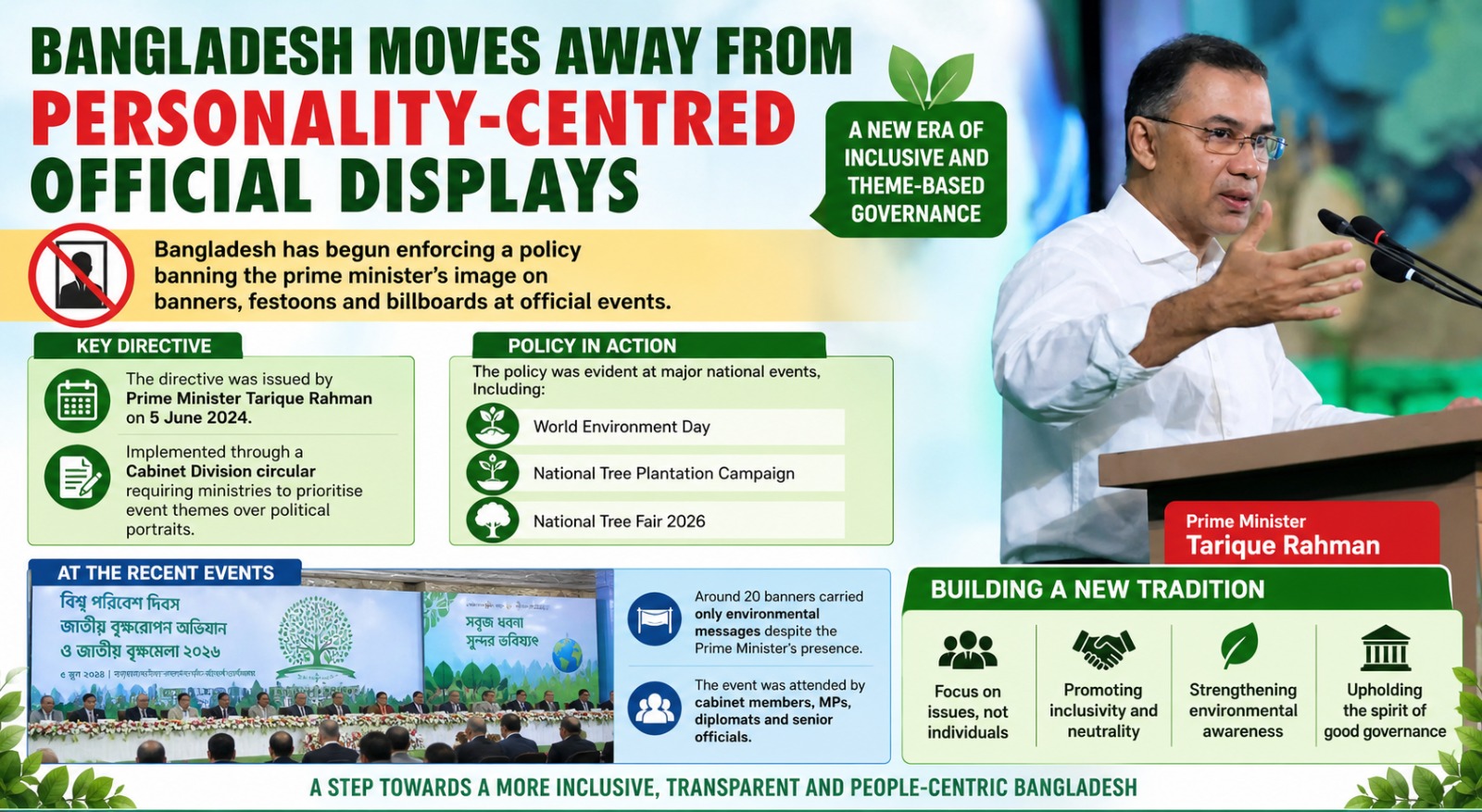
Bangladesh has begun implementing a new government policy banning the use of the prime minister's image on banners, festoons and billboards at official events, marking a significant departure from a long-standing practice in which portraits of the country's top political leaders often dominated public functions.
The change was evident at an event marking World Environment Day, the National Tree Plantation Campaign and the National Tree Fair 2026, organised by the Ministry of Environment, Forest and Climate Change at the Bangladesh-China Friendship Conference Centre in Dhaka.
Although Prime Minister Tarique Rahman attended the programme as chief guest, none of the approximately 20 banners and festoons displayed across the venue featured his photograph. Instead, the displays focused exclusively on environmental protection, biodiversity conservation, tree planting and climate awareness.
The arrangement follows a government directive issued by Prime Minister Tarique Rahman on 5 June, after which the Cabinet Division circulated an official notification prohibiting the use of the prime minister's photograph—whether in 3D or any other format—on banners, festoons or billboards prepared for government programmes.
The circular instructs ministries and public agencies to prioritise the subject matter of each event, ensuring that banners clearly communicate the programme's purpose and relevant public information rather than highlighting political leaders.
For more than a decade, portraits of the president and prime minister routinely dominated official banners, posters, placards and festoons at government meetings, inaugurations and public ceremonies, often overshadowing the themes of the events themselves.
Visitors at Thursday's programme said the new approach made the event's message clearer. Environmental activist Sulaiman Niloy, who attended from Savar, said the absence of the prime minister's portrait reflected the government's directive and allowed greater emphasis on the programme's environmental objectives.
Sanzida Khatun, a student at the University of Dhaka, said previous official events often gave greater prominence to portraits of political leaders than to the purpose of the programme. She described the new policy as a welcome shift towards issue-based public communication.
The event was attended by cabinet members, members of parliament, diplomats, senior government officials and representatives from civil society.