
Sixty-Two Years Too Late
What Runa Laila’s Historic Shilpakala Academy Concert Reveals About Bangladesh’s Cultural Priorities
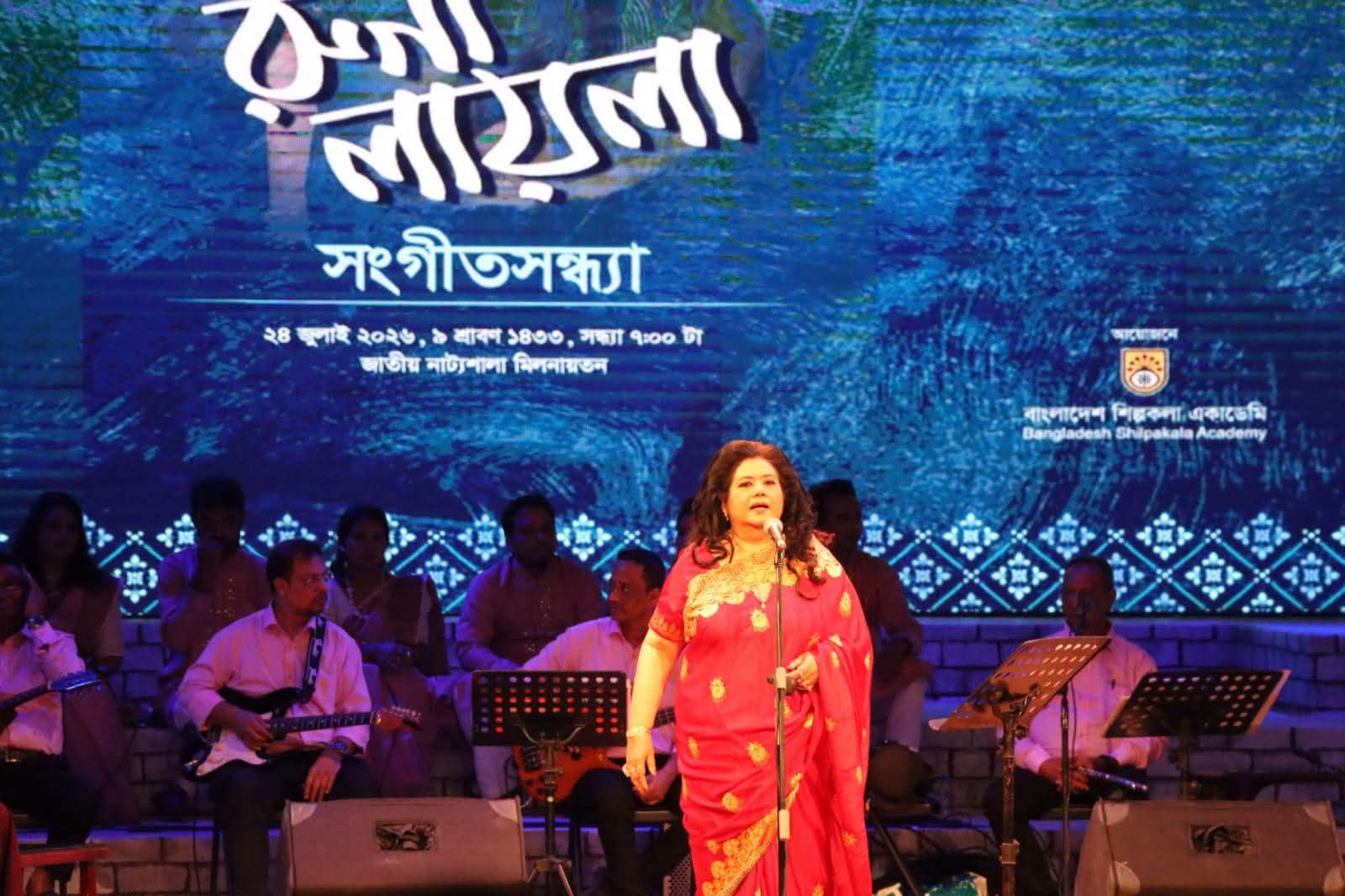
There are moments in a nation’s cultural journey that transcend entertainment and become milestones of national reflection. Legendary singer Runa Laila’s first solo performance at the Bangladesh Shilpakala Academy after an extraordinary sixty-two-year career is one such moment. The concert is undoubtedly a celebration of one of South Asia’s greatest musical icons. Yet it is equally a reminder of an uncomfortable truth: Bangladesh has taken more than six decades to offer one of its finest cultural ambassadors a solo stage at the country’s foremost state cultural institution.
That reality should not diminish the significance of this long-awaited honour. Rather, it should encourage a broader national conversation about how Bangladesh recognises artistic excellence, preserves cultural heritage and projects its identity to the world. Runa Laila’s concert is more than a musical event; it is a reflection of Bangladesh’s evolving relationship with its own cultural memory.
Her graceful observation “It has taken me sixty-two years to perform at my own country’s Shilpakala Academy”was delivered without bitterness or accusation. Yet the simplicity of those words carried enormous historical weight. Sometimes the gentlest statements reveal the deepest institutional shortcomings.
A Voice That Transcended Borders
Few artists from Bangladesh have achieved the regional and international stature enjoyed by Runa Laila. Over six decades, she has built a career that few singers anywhere in the world can match for its longevity, versatility and emotional impact.
She has sung in Bangla, Urdu, Hindi and several other languages. Her repertoire effortlessly bridges modern songs, folk music, Nazrul Sangeet, semi-classical compositions, ghazals and international favourites. Across political borders, linguistic identities and changing musical tastes, her voice has remained remarkably relevant.
Unlike many artists who become associated with a single generation, Runa Laila has spoken to several generations simultaneously. Grandparents introduced her songs to their children; those children later shared the same recordings with their own families. In doing so, her music became part of Bangladesh’s collective emotional inheritance.
This continuity is rare. Artists often enjoy popularity. Very few become permanent fixtures of national memory.
Music and the Making of Bangladesh
The story of Bangladesh itself cannot be separated from music.
The Language Movement of 1952 demonstrated that language and culture could become powerful instruments of political identity. During the Liberation War of 1971, songs became symbols of courage, resistance and hope. Patriotic music travelled alongside freedom fighters, refugees and radio broadcasts, strengthening national morale during one of the darkest chapters in the country’s history.
Since independence, music has continued to define Bangladesh’s cultural landscape.
The works of Rabindranath Tagore, Kazi Nazrul Islam, Abbasuddin Ahmed, Abdul Alim, Feroza Begum, Sabina Yasmin, Syed Abdul Hadi, Subir Nandi, Abdul Jabbar and many others have collectively shaped the country’s artistic identity.
Within that distinguished tradition, Runa Laila occupies a unique position. She represents both national pride and international recognition.
Unlike many celebrated performers whose influence remained largely domestic, Runa Laila became one of the few Bangladeshi artists whose reputation expanded naturally across South Asia and beyond.
In doing so, she helped introduce Bangladesh to audiences who knew little about the country itself.
Soft Power Before the Phrase Became Popular
Today, governments frequently discuss “soft power” the ability to influence global perceptions through culture, education, ideas and creativity rather than military or economic strength.
Yet artists like Runa Laila practised soft power long before policymakers embraced the term. Every international concert served as an informal diplomatic mission. Every recording carried Bangladesh’s artistic identity beyond its borders. Every collaboration strengthened cultural dialogue among neighbouring countries.
The influence of music often extends further than official diplomacy because it reaches emotions rather than negotiations.
Governments may sign agreements.
Artists build affection.
Politicians negotiate relationships.
Musicians create memories.
That distinction matters.
Countries increasingly compete not only through trade or technology but through culture. Films, literature, cuisine, sports and music collectively shape international reputation.
South Korea transformed K-pop into a global industry. Japan projected its identity through design, animation and traditional arts. Spain invested heavily in cultural festivals. France continues to support literature, cinema and classical arts through sustained public funding. Britain’s cultural diplomacy relies significantly upon music, theatre, museums and creative industries. Bangladesh possesses equally valuable cultural resources.
The challenge lies not in creating talent but in systematically supporting and promoting it.
Lessons from India
India offers perhaps the closest regional comparison.
Institutions such as the Sangeet Natak Akademi, the National Centre for the Performing Arts in Mumbai, and major state-sponsored cultural festivals have consistently celebrated living legends while simultaneously nurturing younger artists.
Musicians including Lata Mangeshkar, Manna Dey, Hemanta Mukhopadhyay, Pandit Bhimsen Joshi, Pandit Ravi Shankar, Zakir Hussain and many others received institutional recognition throughout their active careers rather than exclusively after retirement.

Their performances were carefully archived.
Their interviews documented.
Their masterclasses preserved.
Their artistic journeys integrated into national cultural education.
Recognition became part of cultural policy rather than isolated ceremonial gestures.
Bangladesh has begun moving in this direction but remains some distance from establishing equally comprehensive systems.
Pakistan’s Recognition of Musical Heritage
Pakistan presents another instructive example.
Despite political instability and periods of cultural restriction, institutions there have often recognised iconic performers through national television, cultural academies and state honours while those artists remained professionally active.
The country’s celebrated qawwali traditions, ghazal singers and classical musicians have benefited from extensive broadcast preservation.
Artists such as Nusrat Fateh Ali Khan continue influencing global audiences decades after their passing because recordings, documentaries and institutional archives ensured their legacy survived.
Bangladesh possesses equally rich musical traditions.
The question is whether future generations will inherit them through similarly systematic preservation.
Europe’s Model of Cultural Stewardship
Across Europe, cultural institutions operate according to a fundamentally different philosophy.
Artists are regarded not merely as entertainers but as national assets.
Opera houses, orchestras, museums, conservatories and performing arts centres receive sustained public investment because governments recognise culture as infrastructure rather than luxury.

Countries such as Switzerland, Germany, Austria and France maintain extensive archival systems documenting performances, manuscripts, interviews and artistic correspondence.
Major singers often perform repeatedly at national cultural institutions throughout their careers.
Recognition evolves continuously rather than arriving only after decades.
Importantly, European cultural policy frequently links heritage with education.
Students encounter national artists through schools, public broadcasting and local cultural programmes.
The objective extends beyond entertainment.
It seeks continuity.
Each generation inherits not only history but living traditions.
Bangladesh can adapt many of these principles while preserving its own cultural identity.
Why Institutions Matter
Individual talent alone cannot sustain national culture.
Institutions determine whether artistic achievements become permanent national memory.
Libraries preserve books.
Museums preserve artefacts.
Cultural academies preserve living traditions.
When institutions delay recognising their greatest artists, they inadvertently weaken the nation’s own historical record.
Runa Laila herself expressed gratitude rather than disappointment regarding her Shilpakala performance.
Her generosity deserves admiration.
Yet institutional gratitude should never depend upon the patience of artists.
Recognition should arrive naturally, consistently and without unnecessary delay.
This concert therefore raises an important policy question.
How many other distinguished Bangladeshi artists continue waiting for similar institutional appreciation?
The answer deserves careful examination.
Beyond Ceremonial Recognition
Recognition should never end with commemorative concerts.
A comprehensive cultural strategy requires sustained investment.
Bangladesh could establish permanent digital archives documenting performances, interviews, rehearsal footage and musical manuscripts.
Universities could collaborate with cultural institutions to create research centres dedicated to Bangladeshi performing arts.
Schools could incorporate contemporary musical heritage alongside traditional curriculum.

Television broadcasters could regularly air restored archival performances.
Young musicians could receive fellowships allowing them to study directly under senior masters.
These initiatives require resources.
They also require vision.
The financial cost would remain modest compared with the long-term national value created through preserving cultural heritage.
The Economic Value of Culture
Cultural policy is often discussed as though it exists separately from economics.
In reality, creative industries increasingly contribute significantly to national development.
Concert tourism, festivals, digital streaming, music education, cultural exports and international collaborations generate employment while strengthening international reputation.
Countries investing strategically in culture frequently experience broader economic benefits.
Creative industries attract tourism.
They encourage international partnerships.
They strengthen national branding.
Bangladesh’s growing economy presents an opportunity to integrate culture more fully into long-term development planning.
Artists should be viewed not only as cultural ambassadors but also as contributors to sustainable economic growth.
A New Generation Is Watching
Perhaps the greatest significance of Runa Laila’s Shilpakala concert lies not in celebrating the past but in shaping the future.
Young musicians observe how their predecessors are treated.
Institutional recognition influences professional aspiration.
When emerging artists witness living legends receiving thoughtful appreciation, they recognise that excellence retains lasting value.
When they observe neglect, different lessons emerge.
Countries rarely lose artistic talent because creativity disappears.
They lose talent because institutional ecosystems fail to sustain it.
Bangladesh cannot afford such complacency.
Its musical heritage remains among the richest in South Asia.
Protecting that inheritance demands policies extending beyond occasional celebration.
Building a Culture of Appreciation
The Bangladesh Shilpakala Academy deserves genuine appreciation for organising this landmark concert.
Every important institutional reform begins with a first step.
The challenge now is ensuring this occasion becomes precedent rather than exception.
Imagine annual national festivals celebrating living legends.
Imagine comprehensive digital archives freely accessible to researchers worldwide.
Imagine international touring programmes introducing Bangladeshi musical traditions to new audiences.
Imagine partnerships with leading conservatories across Asia and Europe.
Imagine schoolchildren learning directly from master artists through structured educational initiatives.
These ambitions are entirely achievable.
Bangladesh possesses extraordinary artistic resources.
What remains necessary is long-term institutional commitment.
More Than a Concert
Runa Laila’s first solo performance at the Bangladesh Shilpakala Academy ultimately represents far more than an evening of memorable songs.
It symbolises the reunion of a nation with one of its greatest voices.
It acknowledges an artist who has spent more than six decades carrying Bangladesh’s cultural identity across continents, languages and generations.
It also invites thoughtful reflection on how nations honour those who enrich their civilisation.
History demonstrates that societies become culturally confident not simply because they produce exceptional artists but because they recognise, preserve and celebrate them while they remain among us.
Standing ovations are most meaningful when the recipient can hear them.
Tributes carry greater significance when gratitude arrives during a lifetime rather than after it.
Sixty-two years is undoubtedly a long wait.
Yet history often provides second chances.
This concert can become more than overdue recognition.
It can mark the beginning of a new era in Bangladesh’s cultural policy one that places artists at the centre of national identity, regards culture as an essential pillar of development, and understands that music is not merely entertainment but a lasting expression of who a people are.
If Bangladesh embraces that vision, Runa Laila’s long-awaited appearance at the Shilpakala Academy will be remembered not as a story of institutional delay, but as the moment the nation resolved to cherish its cultural treasures before time makes such recognition impossible.
That would be the most fitting tribute to a woman whose voice has already become part of Bangladesh’s history and whose legacy will continue to shape its future for generations to come.
(Writer Shahidul Alam Swapan is a Swiss-based private banking financial crime specialist, columnist, and poet writing on governance, democracy, financial integrity, and international affairs. He could be reached at: shahidul.alam@bluewin.ch)