
World Cup Betting Fuels Bangladesh's Online Gambling Surge
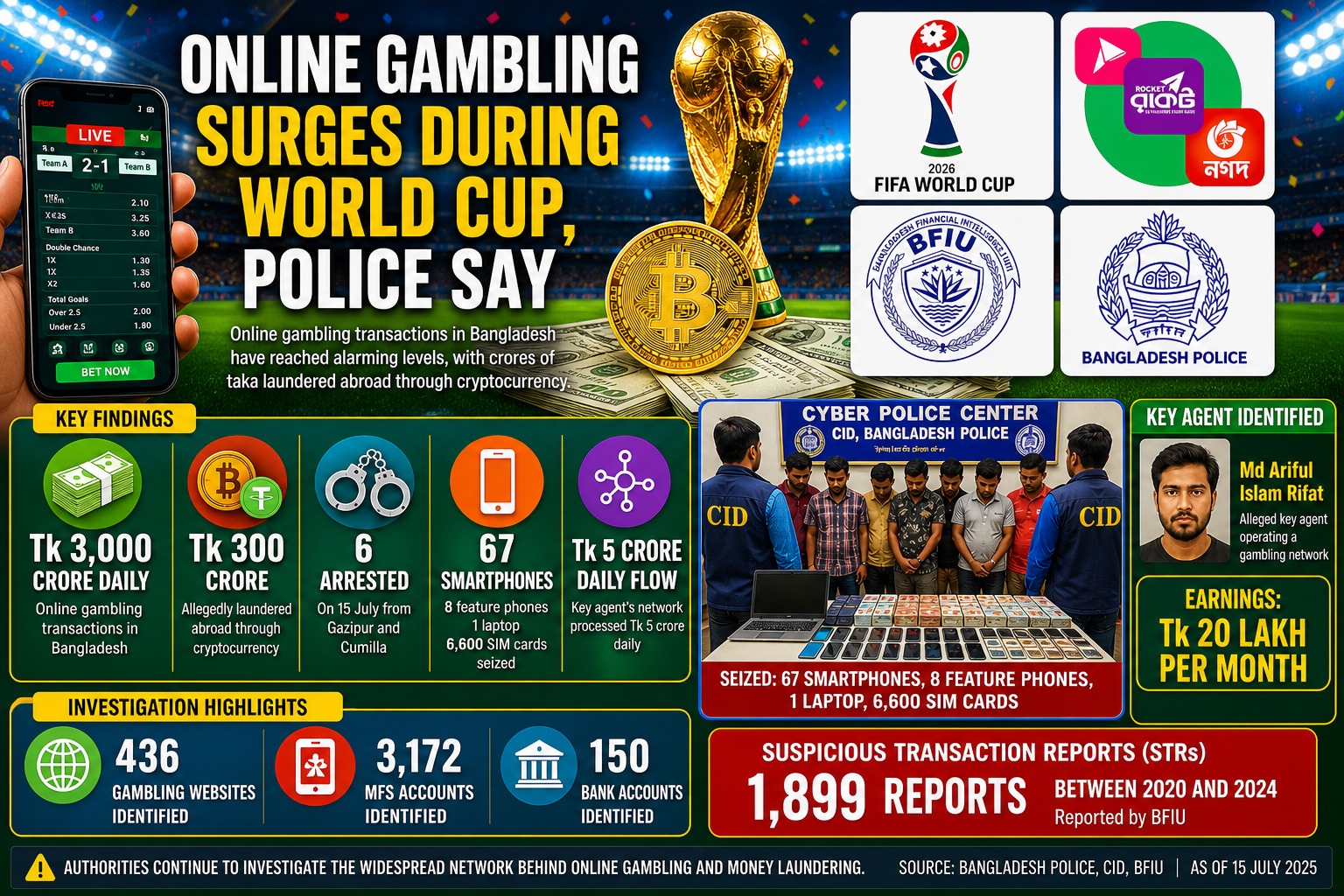
A few taps on a mobile phone screen are all it takes. Within seconds, money is transferred through bKash, Nagad or Rocket, placed on an online casino or sports betting platform, and, in many cases, quietly routed overseas through cryptocurrency. The rapid expansion of online gambling has been further fuelled by the ongoing FIFA World Cup, with betting activity surging as millions of fans follow the tournament.
Investigations by Bangladesh's law enforcement agencies suggest that online gambling has evolved into a sophisticated underground economy controlled by foreign networks, with authorities estimating that transactions worth nearly Tk 3,000 crore take place every day. Police believe around Tk 300 crore is siphoned abroad daily through crypto-based channels, raising fresh concerns over money laundering and financial security.
The scale of the operation came into focus after detectives arrested six people from Gazipur and Cumilla on July 15 for allegedly operating payment gateways for foreign-run online gambling platforms. Detectives seized 67 smartphones, eight feature phones, a laptop and about 6,600 SIM cards, many of them linked to fraudulent mobile financial service (MFS) accounts used to collect betting proceeds before converting the money into cryptocurrency.
Investigators say those arrested were only local facilitators. The networks, they claim, are controlled primarily by foreign operators, including Chinese nationals, who communicate through encrypted messaging platforms, VPNs and anonymous digital wallets.
Among those arrested, investigators identified Md Ariful Islam Rifat as a major gambling agent. According to police, his network processed around Tk 5 crore in transactions every day and generated nearly Tk 20 lakh in monthly earnings. Detectives also found about US$88,000 in two digital wallets allegedly linked to him, which they are now attempting to freeze.
During interrogation, Rifat told investigators that nearly 400 payment gateway networks are currently supporting online gambling operations in Bangladesh. He claimed that roughly 70% of transactions pass through a gateway known as "Pay Kazma", followed by another platform called "GoPay". The money is allegedly collected through MFS agent accounts, transferred to personal accounts, converted into cryptocurrency on Binance, and ultimately sent to overseas digital wallets controlled by gambling operators.
Police officials say the popularity of online gambling has surged since the FIFA World Cup kicked off on June 11, with betting volumes rising sharply during the knockout stage as gamblers wager on match results, goal scorers and other in-game events. Authorities also say gambling platforms have aggressively targeted young people through social media advertisements promising bonuses, easy profits and "risk-free" returns.
Cybercrime investigators warn that university students, unemployed youths, freelancers, members of expatriate families and teenagers accustomed to online gaming have become the primary targets. While some users initially receive winnings, many eventually lose significant sums, leaving them trapped in debt and, in some cases, pushed towards theft, fraud and other criminal activities.
The Criminal Investigation Department (CID) said its Cyber Police Center identified 436 online gambling websites between May 1 and July 14 and requested the Bangladesh Telecommunication Regulatory Commission (BTRC) to block them. The agency also traced gambling-related transactions through 3,172 MFS accounts and 150 bank accounts and referred the information to the Bangladesh Financial Intelligence Unit (BFIU).
Financial intelligence data indicate that the problem extends well beyond isolated criminal cases. According to the BFIU's latest annual report, the agency received 1,899 suspicious transaction reports linked to online gambling, betting and cryptocurrency between 2020 and 2024. During the same period, the number of investigation reports rose from just 50 to 1,046.
Authorities identified 6,222 bank and MFS accounts allegedly connected to these activities, through which Tk 6,144.15 crore was deposited and Tk 4,349.75 crore withdrawn. The report found suspicious transactions across a wide range of professions, including salaried employees, homemakers, farmers, students, freelancers and information technology professionals, suggesting that illegal digital financial networks have spread across both urban and rural Bangladesh.
Responding to the growing threat, the government enacted the Gambling Prevention Act 2026 on July 1, introducing penalties of up to seven years' imprisonment and fines of up to Tk 5 crore for those involved in online gambling.
Financial institutions have also tightened surveillance. Banks and mobile financial service providers say they are increasingly relying on automated transaction monitoring systems to detect suspicious activity and report it to the BFIU.
Officials and cybersecurity experts, however, caution that enforcement alone will not be enough. They argue that stronger digital surveillance, closer coordination among regulators, faster disruption of illegal payment networks and greater public awareness will be essential to curb a rapidly expanding criminal economy that is exploiting Bangladesh's fast-growing digital financial ecosystem.