
Bangladesh Introduces Austerity Drive for FY2026–27
The Bangladesh government has announced a broad package of austerity measures for the 2026–27 fiscal year (FY2026–27), suspending or restricting spending across several sectors as part of efforts to ensure prudent use of public funds, contain inflation and preserve macroeconomic stability amid continued fiscal pressures.
The directives were issued in a circular by the Finance Division of the Ministry of Finance on Wednesday (July 8). The circular, signed by Deputy Secretary Mohammad Zakir Hossain, will apply to all government ministries and divisions, autonomous and statutory bodies, state-owned corporations, government-owned companies and state financial institutions.
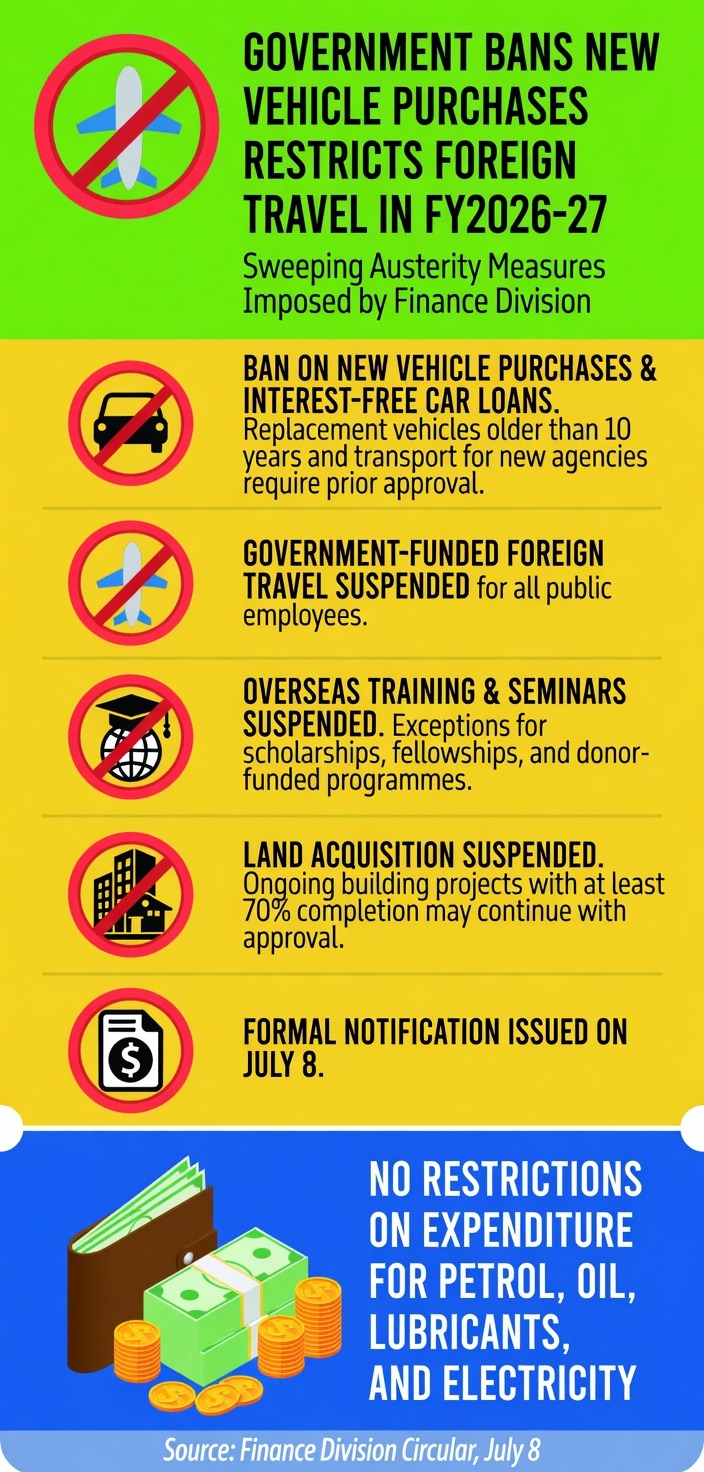
Under the new measures, the government has banned the purchase of new motor vehicles, watercraft and aircraft under both the operating and development budgets. However, limited exceptions have been allowed. Government agencies may replace vehicles that are more than 10 years old and purchase transport for newly established institutions included in their approved organisational structure (TO&E), subject to prior approval from the Finance Division.
The circular also stipulates that, except for ambulances and vehicles used for security purposes, all newly purchased or replacement government cars and jeeps must be fully electric vehicles, reflecting the government's commitment to reducing fuel costs and promoting environmentally sustainable transport.
The Finance Division has also suspended spending from all types of block allocations under economic codes 3911111 and 4911111.
Construction of new residential, non-residential and other government buildings under the operating budget has also been halted. Only projects that have already achieved at least 70% physical completion will be allowed to continue after obtaining approval from the Finance Division.
The government has further imposed a ban on spending for land acquisition under the operating budget. Under the development budget, however, land acquisition may proceed only after completing all required legal formalities and securing prior approval from the Finance Division. Similarly, expenditure from the government's reserved allocation under the "Special Development Assistance" fund for the Planning Commission will require prior approval.
In another major cost-cutting measure, the government has suspended interest-free special advances and loans previously provided to public servants for purchasing personal vehicles.
The circular also introduces strict restrictions on government-funded foreign travel. Public officials will no longer be allowed to participate in overseas training programmes, seminars, symposiums or workshops financed by the government.
Certain exceptions remain. Officials may travel abroad for postgraduate and doctoral studies if funded through scholarships or fellowships provided by development partners, foreign governments, universities or international institutions. Participation in overseas training programmes financed by foreign governments, international organisations or development partners will also remain permissible.
Additionally, the foreign component of mandatory training programmes conducted by government training institutes may continue if organised through recognised universities or accredited institutions abroad.
For technical procurement, the government has allowed overseas travel only in limited cases involving pre-shipment inspections or factory acceptance tests for highly specialised equipment where such inspections are mandatory. Even in those cases, authorities have been instructed to prioritise internationally accredited certification agencies whenever possible instead of sending officials abroad.
The Finance Division has directed all ministries and agencies to ensure the most efficient and economical use of public funds under both the operating and development budgets. The latest austerity measures are aimed at strengthening fiscal discipline, improving expenditure management and safeguarding the country's macroeconomic stability amid ongoing economic challenges.