
The Exercise of Regarding Everything Like Commodities and Karl Marx’s Visionary Paradigms
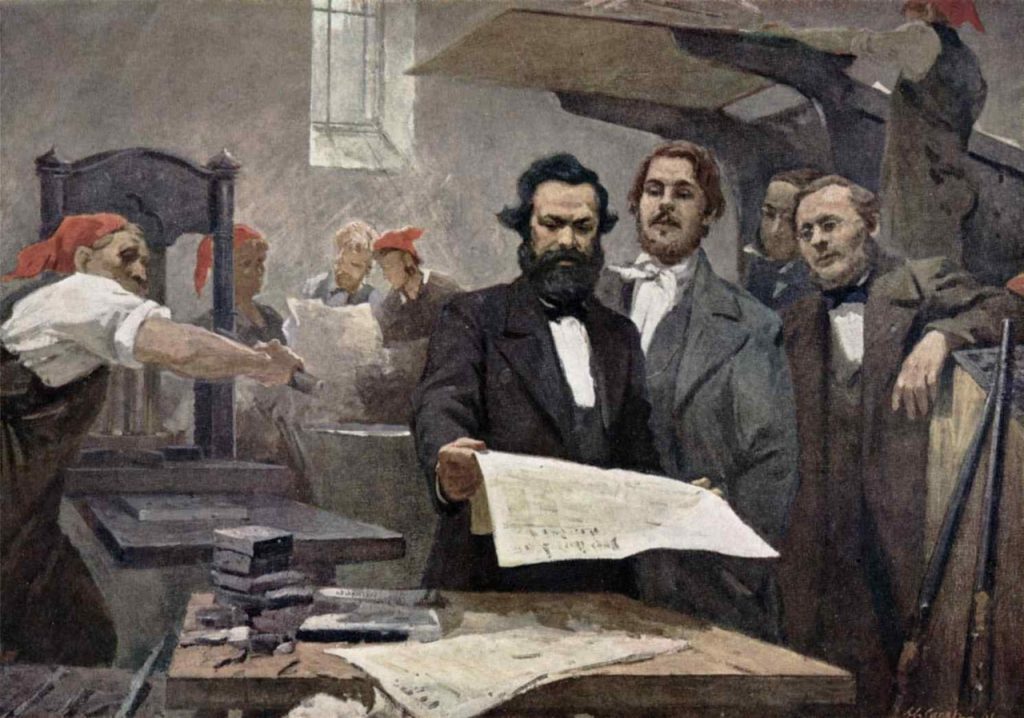
German philosopher and the founder of communism Karl Marx’s relationship with Friedrich Hegel (1770—1831) was one of critical inheritance, where Marx adopted Hegel's dialectical method but rejected his idealism. Marx famously "turned Hegel on his head," replacing Hegel's focus on the "Absolute Spirit" with material conditions as the driving force of history.
Most people who have studied Marxism have probably come across the popular phrase: “Marx turned Hegel’s philosophy right side up.” This conclusion is derived from a rather shallow depiction of Karl Marx’s materialist reconstruction of Hegel’s idealist philosophy. It is hard to argue against this phrase, as it is based on an actual quote by Karl Marx (1818—1883) from his masterwork Das Capital. Karl Marx stood all tests of time and still his ideas go strong in academia worldwide. His ideology and theories are taught in thousands of universities all over the world in classes on literature, history, political studies and economics.
Although an extreme over-simplification, this basic idea holds some truth. Karl Marx was a follower of Hegel, at least when he was one of the Young Hegelians. Then he built his own thought through an interpretation and critique of Hegel’s philosophy. But did Marx really turn Hegel’s philosophy right side up? Why did he perceive Hegel’s philosophy as upside down? Was Marx’s criticism of Hegel sound? Are there Hegelian traces in Marx’s philosophy? These are some of the questions that arise when a comparison between these two towering philosophers is drawn.
If Karl Marx turned Hegel’s philosophy right side up, this implies that he did not simply reject Hegel’s philosophy. Marx made use of Hegel’s ideas but in a reversed method. After all, the ultimate goal in both philosophers’ theories was human freedom, though they believed it would be reached in different ways. Similarities can be seen even through an overview of the outlines of the two philosophies. Both philosophers examined patterns of development in human history, by which they attempted to understand modern society. Marx went further and produced a theory in accordance with these patterns of history to figure out what needs to be done for societies to progress. On the other hand, Hegel believes that we cannot rationally aim for an ideal like Marx’s communism, as historical progress happens naturally, by itself. The inverse dialectical methods they use are reflected in the roles they give to philosophy.
The main reason Karl Marx opposed Hegel’s passive attitude is that Marx thought our ideas are shaped by material circumstances. According to Karl Marx, the economic base – the relations of production – predominantly influences the superstructure – culture, science, ideology, religion, politics etcetera – of a society. Therefore, he believed that we cannot simply expect people to change minds without changing the world first.
Ideology helps an individual to comprehend truth in society. Karl Marx believed that societies could only be understood in terms of material possessions. Karl Marx saw history as a revolution in the modes of production. The history changed from feudal mode of production to the current capitalistic mode.
In the current mode, human life is characterized by competition, subjugation, pauperization and hopelessness. All these can only be rectified through a revolution. The proletariat should rise up against the bourgeoisie and claim leadership.
For Hegel, the lives of people in society are influenced by objects, which are needed in case life is to proceed well. The same objects are the major causes of alienation. The objects are needed by individuals to accomplish their tasks. Without the objects, people can do nothing to satisfy their needs.
Therefore, the religious leaders utilize the objects to dominate and suppress the poor. From Hegel’s analysis, it is evident that alienation is inevitable in human history. Alienation is natural to human beings, which is shaped by objects. The objects keep on changing in shape and form.
It reaches a time when human beings dispute the existing structure by arguing that some objects are unnecessary. Alienation to Karl Marx does not pertain to human objects instead, it relates to production of goods and services in society. It is more concerned about ownership of the means of production.
Hegel observed that labor was a positive activity in human history. However, Karl Marx differed with him since labor is evil meaning that it causes alienation and domination in society. In fact, to Karl Marx, labor is the main cause of alienation.
Hegel viewed alienation to be inherently in people but Marx narrowed it down to an individual. An individual is alienated from his own activities since he or she does not have any time to conduct private activities apart from animal related ones such as eating, sleeping and procreating.
Workers produce goods that they do not consume meaning they produce for others. The increase in product value decreases the viability of workers. The worker ends up being treated in the same way as goods implying that goods and workers are treated as equals.
Workers are perpetually pushed to the periphery leading to alienation from the process of production. The way workers relate to the whole process of production leaves a lot to be desired because the relationship is unnatural and uncalled for.
The workers never find satisfaction because they satisfy the interests of the capitalists. The worker views the whole process of production as forced labor because actually it is inhuman. The worker ends up being alienated from the self because of the last two forms of alienation.
The worker portrays two personalities. One is the feeling of belonging to capitalism because the worker is separated from real consciousness. On the other hand, workers perceive themselves as human beings. In today’s world we find working class people being subjected to dehumanization by business owners and industrialists. Hard work actually does not carry any substantial value in the present capitalistic world order. If hard work mattered, every farmer would be a billionaire but the reality is absolutely opposite because the system promotes exploitation, not effort. For the same reason fighting corruption and establishing socioeconomic justice is becoming all the more difficult all over the globe. Capitalism treats the world like a shopping mall where everything is objectified and goes on sale including beliefs, ideologies, self-esteem, relationships, commitments and so on. In socialist terms it’s known as “commoditification” which means turning everything into commodities like consumer products we see in supermarkets.
(Mahfuz Ul Hasib Chowdhury is a contributor to different English newspapers and magazines.)