
Bangladesh’s electric bus project stalls amid funding and depot delays
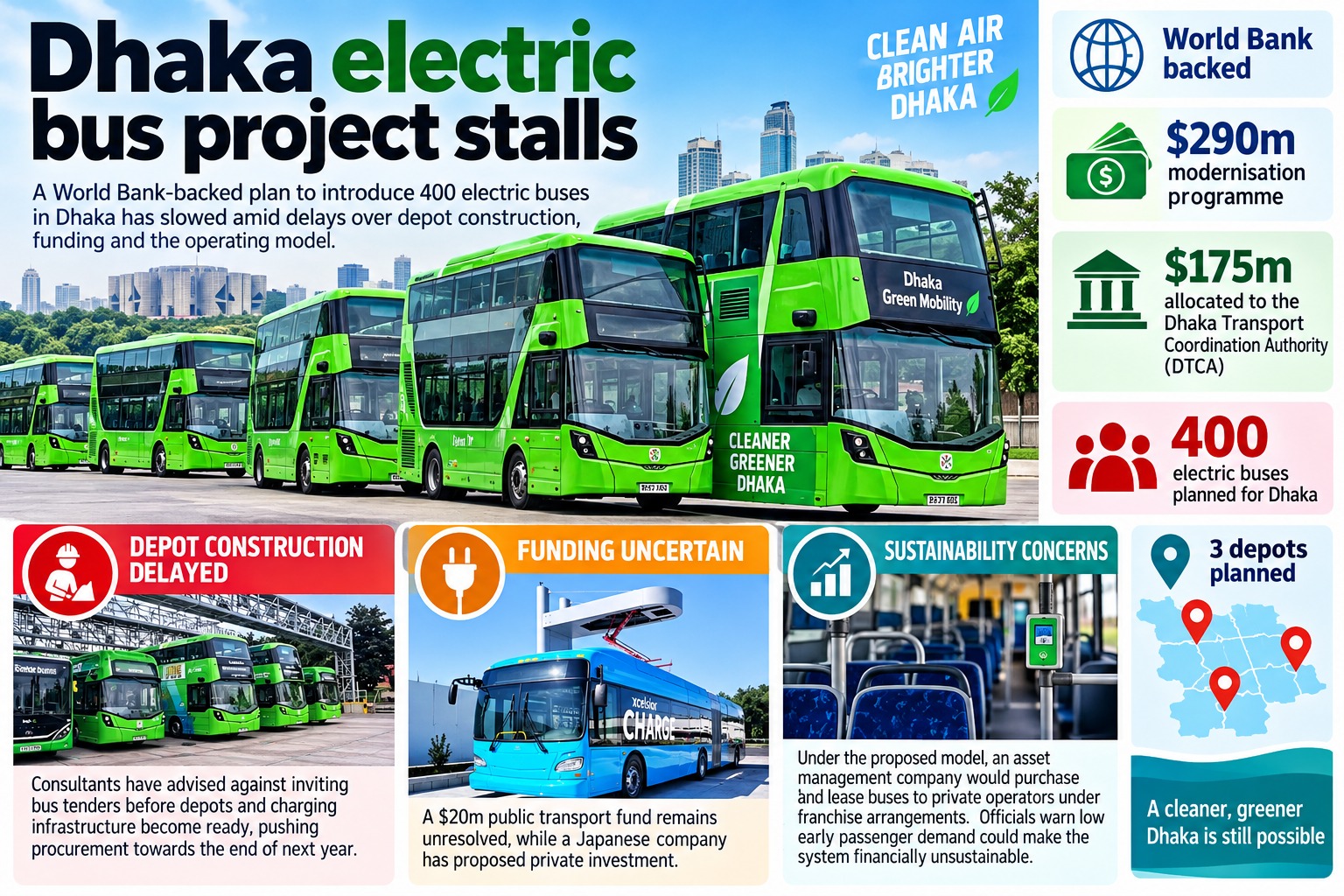
A World Bank-backed plan to introduce 400 electric buses in Dhaka has slowed amid delays over depot construction, funding arrangements and uncertainty about how the new fleet will operate.
The project forms part of the $290m Bangladesh Clean Air Project-Dhaka Bus Modernisation Programme, under which the Dhaka Transport Coordination Authority (DTCA) has been allocated $175m. Components involving the Department of Environment and the Bangladesh Road Transport Authority account for the remainder.
Officials involved in the project say the procurement of the electric buses cannot move ahead until the necessary depots are ready. Consultants have advised against inviting tenders before the charging and maintenance infrastructure is in place, pushing the procurement process towards the end of next year.
The delay has also exposed questions over the financial sustainability of the proposed operating model.
Under the plan, an asset management company, or AssetCo, would purchase the buses and lease them to private operators. The fleet would run on three or four routes under a franchise-based system, while a separate fare collection agency would collect passenger revenue.
Operators and the AssetCo would receive payments based on kilometres operated. But officials warn that the model could face financial pressure if passenger demand remains weak during the early years and fare revenue fails to cover the required payments.
To address that risk, project officials had proposed a $20m public transport fund within DTCA’s $175m allocation. The proposal was rejected during the interim administration over concerns about increasing the government’s foreign borrowing burden.
After the BNP government took office, project officials held further discussions with the finance and planning authorities and sought government funding for the public transport fund instead of financing it through the World Bank loan.
The project has also attracted interest from a Japanese private company, which has proposed investing in the bus service without relying on government financial support or a public transport fund. Its proposal would focus on commercially viable routes and generate additional income through advertising and small-scale parcel delivery.
Documents discussed at DTCA meetings show that officials have been examining three broad operating models: public-private partnerships, gross-cost contracts and franchise arrangements.
The documents caution that a conventional PPP may fail to attract sufficient private investment across Dhaka’s entire bus network because investors are likely to favour profitable routes. Less profitable routes could therefore require viability-gap funding or other government support.
A gross-cost or franchise model, by contrast, would allow the authorities to plan services across the network while separating fare collection from bus operations.
AssetCo at the centre of the proposed model
The programme aims to bring Dhaka’s fragmented private bus operators into a formal franchise system. Under the proposed structure, AssetCo would own or finance the buses and manage major technology and lifecycle risks, while operators would concentrate on providing the service.
Project officials argue that private bus owners have limited experience with electric-bus technology, batteries and long-term maintenance. AssetCo would therefore negotiate with original equipment manufacturers, establish maintenance arrangements and manage battery and technology risks.
Preliminary discussions have taken place with IDCOL about the possible role of AssetCo. BRTC, DTCA and the Bangladesh Infrastructure Finance Fund Limited have also emerged as possible candidates.
If no suitable public or semi-public institution can take on the role, the project could appoint a private AssetCo through a competitive procurement process.
Financial institutions consulted during the project’s preparation have expressed concern about the technology risks associated with electric buses and the credit and operational risks of new operators. One proposal therefore calls for a public or semi-public AssetCo to absorb some of the initial risks and establish a track record before greater private-sector participation.
Under the proposed financing structure, about 80% of the cost of the 400 buses – roughly $60m – would come through AssetCo financing. A further 10% would come from AssetCo equity and 10% from bus operators.
AssetCo would receive payments based on the number of kilometres operated by its buses.
Three depots planned
Depot construction remains one of the biggest obstacles to the programme.
The first depot is planned on 7.13 acres of government-owned land in Purbachal, with infrastructure capable of accommodating 486 buses. A second depot is being pursued at the Jhilmil project, alongside efforts to establish a city bus terminal.
Officials say having depots at opposite ends of the city would make operations easier and reduce logistical pressure on the network.
An earlier plan to establish a depot at Kanchpur failed to materialise.
For now, the electric-bus programme remains caught between infrastructure requirements, financing concerns and the challenge of creating a viable operating system. Until those issues are resolved, Dhaka’s proposed transition to electric public transport is unlikely to move quickly from planning documents to the road.