
Inflation falls on paper, but somehow misses Bangladesh’s markets
Bangladesh’s new BNP government appears to have achieved an unusual economic feat: inflation is falling—at least on paper. For millions of consumers, however, the good news has apparently failed to reach the country’s markets.
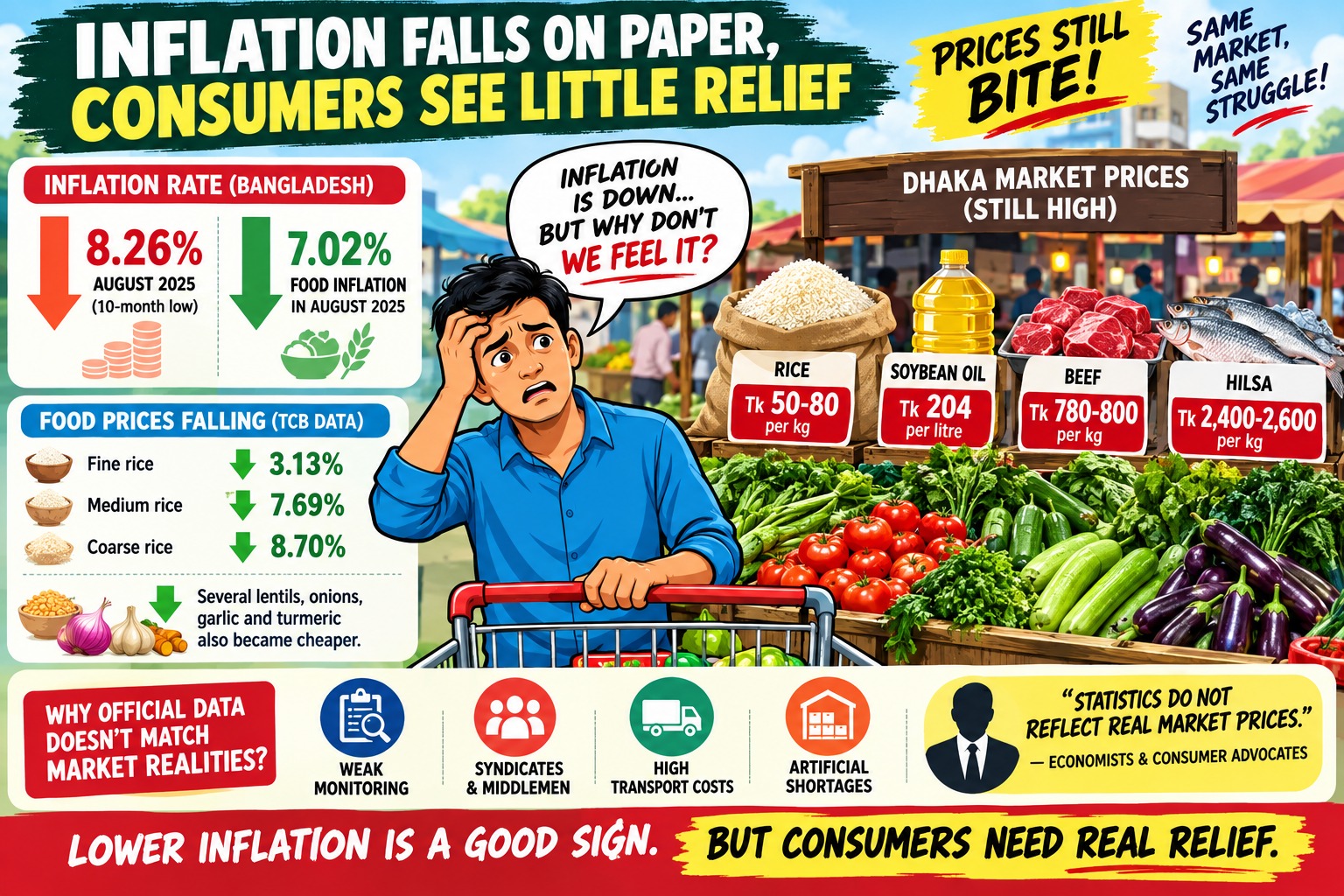
According to the Bangladesh Bureau of Statistics (BBS), headline inflation fell to 8.26 percent in August, its lowest level in 10 months, from 8.32 percent in July. Food inflation also declined, from 7.16 percent to 7.02 percent.
The numbers look encouraging. The shopping bills tell a rather different story.
The government’s statistics suggest that several essential commodities have become cheaper. The Trading Corporation of Bangladesh (TCB), comparing prices with the same period last year, reported that fine rice prices fell by 3.13 percent, medium-grain rice by 7.69 percent and coarse rice by 8.70 percent. Prices of several varieties of lentils, chickpeas, onions, garlic and turmeric were also reported to have declined.
Consumers visiting Dhaka markets, however, may be forgiven for wondering whether they have entered the wrong country.
Fine rice is selling for Tk75-80 a kilogram, medium rice for Tk55-60 and coarse rice for Tk50-52. Large-grain lentils cost around Tk82, medium-grain lentils Tk135 and small-grain lentils Tk155.
So, according to the statistics, prices are falling.
According to the shopping bag, not quite.
The disconnect has raised questions about the reliability of official inflation data and whether government agencies are adequately capturing what consumers actually pay at retail markets.
A H M Shafiquzzaman, president of the Consumers Association of Bangladesh, said official figures showing price declines often do not match what is seen in markets. While BBS reports falling inflation, he said ordinary people continue to struggle with the rising cost of living.
Former National Board of Revenue chairman Dr Md Abdul Majid also questioned the availability of reliable market information. He said shortages of manpower in government agencies have long raised concerns about whether authorities can properly collect data on prices, stocks and supplies.
In other words, Bangladesh may have a statistical inflation problem—but consumers have a grocery problem.
The irony becomes even sharper when the prices of other essentials are considered.
Soybean oil is selling at around Tk204 a litre, palm oil at Tk186 a kilogram, while green chillies cost Tk160-200, eggplant Tk100-160 and cucumber Tk70-100. Garlic costs Tk150-180 a kilogram and ginger Tk160-170.
The meat and fish markets offer little relief. Beef costs Tk780-800 a kilogram, mutton around Tk1,250 and broiler chicken Tk180-190. A kilogram of hilsa costs Tk2,400-2,600, while pangas sells for Tk280-300.
For consumers, the government’s declining inflation rate therefore creates a curious situation: the percentage is becoming smaller while the shopping bill remains stubbornly large.
Economists say the problem goes beyond statistics. Professor Selim Raihan of Dhaka University and executive director of the South Asian Network on Economic Modeling said the decline shown in official data is not reflected in the marketplace. Income growth, he noted, has failed to keep pace with the increase in the prices of essential goods.
Government reports have identified several reasons for the persistent gap between wholesale and retail prices, including transport costs, extortion, market manipulation, artificial shortages and weak monitoring.
That leaves the BNP government with an awkward question.
If inflation is falling, why does the average consumer still need more money to buy the same basket of necessities?
Perhaps the answer lies in a new economic principle: inflation can fall statistically while the cost of living continues rising practically.
The government can celebrate the numbers.
Consumers, meanwhile, can celebrate when the numbers finally appear at the market.
Until then, Bangladeshis may have to choose between two realities: the one printed in official reports—and the one printed on their grocery receipts.