
Cash returns to Bangladesh banks after Eid surge
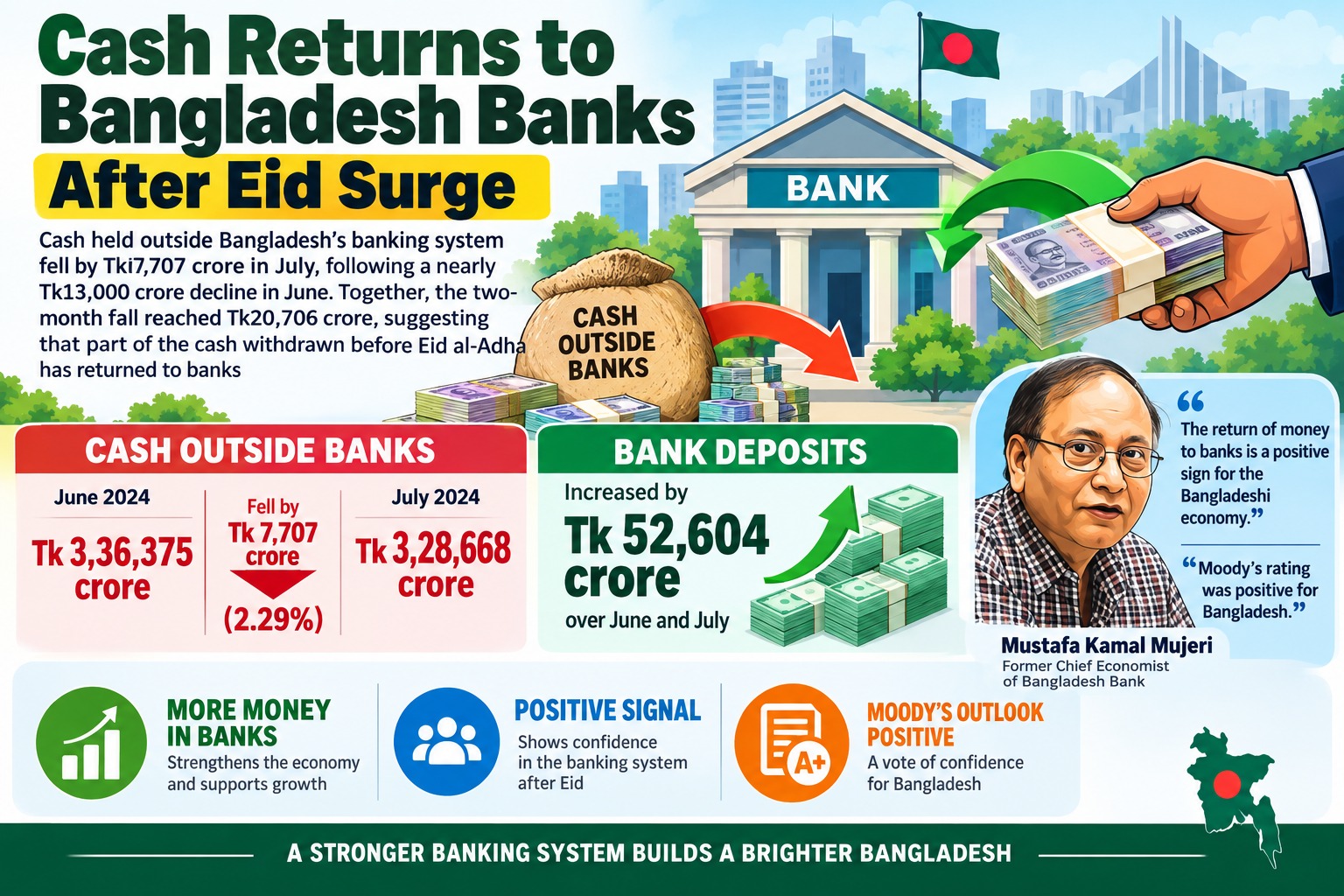
Billions of taka withdrawn ahead of the Eid al-Adha holiday are gradually returning to Bangladesh’s banking system, with cash held outside banks falling by more than Tk20,700 crore over two month.
Cash held by people outside the banking system fell by Tk7,707 crore in July, following a decline of almost Tk13,000 crore in June, according to updated data from Bangladesh Bank.
Together, the two-month decline reached Tk20,706 crore, suggesting that at least part of the huge volume of cash withdrawn ahead of Eid al-Adha has gradually found its way back into bank accounts.
At the end of July, cash in circulation outside banks stood at Tk3 lakh 28 thousand 668 crore, down from Tk3 lakh 36 thousand 375 crore at the end of June. The monthly decline was 2.29%.
The fall followed an exceptional rise in May, when cash outside banks jumped by Tk49,949 crore as households and businesses prepared for Eid al-Adha.
he festival typically generates heavy cash transactions across the economy. Livestock purchases, cattle-market transactions, payments to butchers and workers, and the processing and distribution of sacrificial animals all increase demand for physical currency.
Banking sector officials and economists describe the surge as largely seasonal. Once the festival ends and cash-intensive transactions decline, some of the money returns to banks.
The latest figures indicate that process continued through June and July.
The return of cash is also visible in bank deposits, which rose by more than Tk52,600 crore during the same two-month period.
According to Bangladesh Bank, total deposits in the banking sector reached Tk20 lakh 93 thousand 704 crore at the end of July, compared with Tk20 lakh 79 thousand 297 crore a month earlier.
That represented an increase of Tk14,407 crore in July. In June, deposits had risen by Tk38,197 crore.
Combined, deposits increased by Tk52,604 crore during June and July.
The pace of growth, however, slowed in July. Deposits increased by 0.69% during the month, compared with about 1.87% in June. Mustafa Kamal Mujeri, Executive Director of the Institute for Inclusive Finance and Development and former Chief Economist of Bangladesh Bank, said, “It is a positive sign for the Bangladeshi economy as more money is returning to the banking sector. Moody’s rating is also positive for Bangladesh.”
The figures suggest that the post-Eid return of cash is taking place alongside a broader increase in bank deposits, although the relationship between the two cannot be established from the data alone.People may also be keeping less physical currency as regular salaries, business payments and other transactions increasingly move through banks and digital channels.
Yet the latest decline has not erased the longer-term rise in cash outside the banking system.
At the end of July last year, cash outside banks stood at Tk2 lakh 87 thousand 294 crore. By July this year, it had reached Tk3 lakh 28 thousand 668 crore.
That represents an increase of Tk41,374 crore, or 14.41%, in a year.
The contrast highlights the unusual nature of the recent movement. Cash has fallen sharply from its Eid-related peak, but the amount of currency circulating outside banks remains substantially higher than a year earlier.
The same pattern appears in deposits.
Bank deposits stood at Tk18 lakh 80 thousand 108 crore at the end of July last year. Twelve months later, they had risen to Tk20 lakh 93 thousand 704 crore – an increase of roughly Tk2 lakh 13,600 crore, or 11.36%.
For banks, the return of cash following Eid provides additional liquidity and supports deposit growth. For the wider economy, however, the figures offer a more complicated picture.
A large volume of physical cash outside banks can reduce the funds available within the formal financial system, while a return of that money can strengthen banks’ deposit base.
The recent movement therefore reflects both a familiar seasonal cycle and a broader change in the country’s monetary landscape.
The May surge shows how quickly cash demand can rise when a major festival brings together millions of households, livestock traders, workers and small businesses.
The subsequent decline shows that much of that money does not necessarily remain outside the banking system.
But with cash outside banks still 14.41% higher than a year ago, the return remains incomplete. The coming months will show whether the post-Eid fall marks a lasting shift towards bank deposits or simply the unwinding of a seasonal spike.