
Tarique Rahman’s UN Debut at the 81st General Assembly
Bangladesh’s democratic reassertion, the Rohingya imperative, and a new global vision
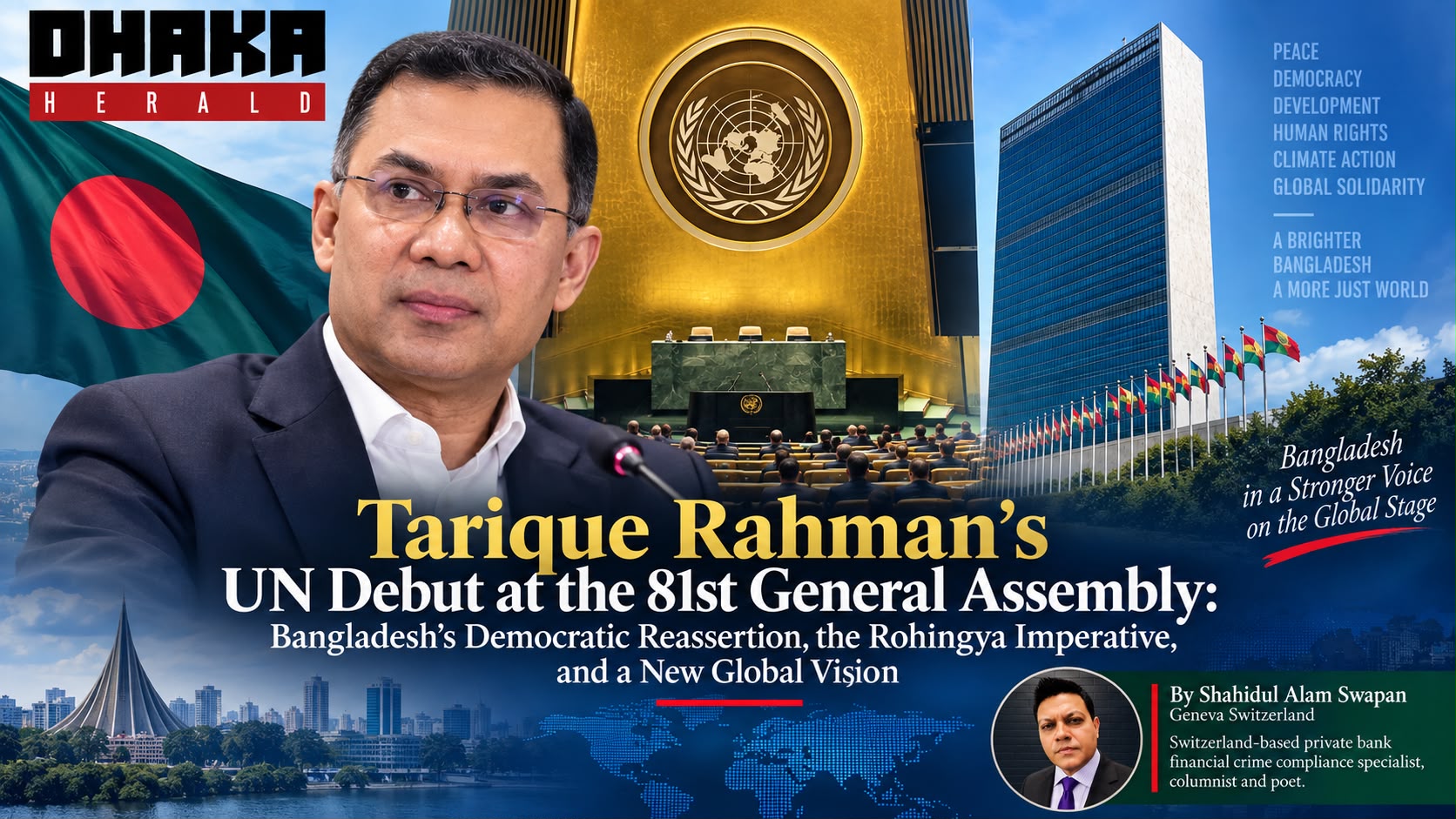
As Prime Minister Tarique Rahman prepares to address the 81st Session of the United Nations General Assembly (UNGA) on 24 September, Bangladesh stands at a pivotal moment in its political and diplomatic history. His maiden appearance before the world’s foremost multilateral forum will be more than a ceremonial debut. It will serve as the first comprehensive presentation of the new government's political philosophy, democratic commitments, development priorities, and foreign policy outlook before the international community.
The significance of the address extends far beyond the traditional annual speeches delivered by heads of government at the United Nations. For Bangladesh, it represents an opportunity to define a new chapter in its national narrative following a period of profound political transition. For the international community, it offers insight into how the country's new leadership intends to navigate a rapidly changing global order marked by geopolitical rivalry, economic uncertainty, climate vulnerability, conflict-driven displacement, and widening inequality.
Observers expect the prime minister's speech to focus on three broad themes: the restoration and strengthening of democratic governance in Bangladesh, the country's continued pursuit of inclusive development and international cooperation, and the urgent need for renewed global action on the Rohingya crisis. Together, these themes are likely to form the foundation of Bangladesh's message to the world.
A Landmark Appearance on the Global Stage
Every first address by a national leader at the United Nations carries symbolic and political importance. Tarique Rahman's appearance will be especially scrutinised because it comes at a time when Bangladesh is seeking to project a renewed image internationally.
The prime minister's speech is expected to highlight what the government describes as Bangladesh's renewed democratic journey. Such a message is likely to emphasise institutional strength, political accountability, the protection of civil liberties, and the rebuilding of public trust in democratic processes. By presenting these commitments before the UN General Assembly, the government aims to reassure international partners, development institutions, and global investors about the country's political direction.
The address is also expected to reflect Bangladesh's determination to remain a constructive player in multilateral diplomacy. Since independence, Bangladesh has consistently advocated dialogue, peaceful conflict resolution, decolonisation, climate justice, and global solidarity. The new leadership appears poised to reaffirm these longstanding principles while adapting them to contemporary challenges.
Bangladesh's Vision for the Future
Beyond political messaging, the speech is likely to outline a broad vision for Bangladesh's future. The government is expected to emphasise economic resilience, employment generation, technological transformation, human resource development, and social inclusion.
Bangladesh has achieved remarkable socio-economic progress over the past several decades. However, the country now faces a more complex set of challenges. Inflationary pressures, global supply chain disruptions, climate-related disasters, energy security concerns, and demographic pressures require new approaches to governance and economic management.
In this context, Tarique Rahman is expected to present a roadmap centred on sustainable growth, modernisation of state institutions, investment in education and innovation, and the expansion of opportunities for young people. Such themes are particularly relevant because more than a third of Bangladesh's population is under the age of 35, making youth empowerment a critical national priority.
At the international level, Bangladesh is also expected to advocate for fairer global economic structures. Developing countries continue to face difficulties in accessing affordable financing, technology, and climate adaptation resources. The prime minister may call for reforms that enable emerging economies to pursue development without being constrained by structural inequalities within the global system.
Renewed Focus on the Rohingya Crisis
Perhaps the most closely watched aspect of the prime minister's UN engagement will be his emphasis on the Rohingya issue.
For nearly a decade, Bangladesh has hosted more than a million Rohingya refugees who fled persecution and violence in Myanmar. The crisis remains one of the world's largest and most protracted refugee situations. Despite repeated discussions at international forums, a durable solution has remained elusive.
The prime minister's address is expected to seek renewed international attention to a crisis that many policymakers fear is gradually slipping from the global spotlight. Bangladesh has repeatedly argued that the burden of hosting such a large displaced population cannot be sustained indefinitely by one country alone. As humanitarian funding declines and geopolitical attention shifts to other crises around the world, concerns have grown regarding the future of refugee assistance and regional stability.
Tarique Rahman is expected to reiterate Bangladesh's longstanding position that the only sustainable solution lies in the safe, voluntary, dignified, and sustainable repatriation of the Rohingya people to Myanmar. He is also likely to call upon major powers, regional actors, international organisations, and development partners to intensify diplomatic efforts aimed at creating conditions conducive to repatriation.
The issue carries profound implications not only for humanitarian policy but also for regional security. Prolonged displacement, inadequate funding, and uncertainty about future prospects can create conditions that threaten stability both within refugee camps and across the wider region. Through his UN speech, the prime minister will likely argue that resolving the crisis serves the interests of the entire international community.
The Bangladesh-Hosted Rohingya Side Event
Ahead of his General Assembly address, the prime minister is scheduled to participate in a Bangladesh-hosted side event dedicated to the Rohingya issue on 23 September.
Such side events often serve as important diplomatic platforms where governments, UN agencies, donor nations, and humanitarian organisations engage in detailed discussions outside the formal plenary sessions. The event is expected to provide Bangladesh with an opportunity to highlight ongoing challenges in refugee management, humanitarian financing gaps, and the continued absence of meaningful progress toward repatriation.
The gathering may also be used to mobilise broader international support and encourage renewed commitments from donor countries. With global humanitarian resources increasingly stretched by multiple conflicts and displacement crises, securing sustained international assistance remains a key priority for Bangladesh.
Addressing Global Inequality
The prime minister's schedule also includes participation in a high-level meeting focused on tackling global inequality, a topic that has become increasingly prominent in international policy debates.
The widening gap between developed and developing countries has been exacerbated by economic shocks, climate impacts, debt burdens, technological disparities, and unequal access to financial resources. Bangladesh is expected to advocate a more equitable international framework that recognises the distinct challenges faced by developing nations.
Issues such as unfair trade barriers, technology transfer, climate financing, debt sustainability, and access to development funding are likely to feature prominently in discussions. As a rapidly developing country navigating the transition toward higher income status, Bangladesh occupies a unique position from which to articulate the concerns of many countries in the Global South.
Tarique Rahman's intervention at the meeting may underscore the necessity of transforming international institutions and financial mechanisms so that development opportunities are distributed more fairly across nations.
Championing Maternal and Newborn Health
Another key engagement during the UNGA session will be a Bangladesh-hosted side event focused on maternal and newborn health and midwifery.
Bangladesh has long been recognised internationally for significant progress in improving maternal and child health outcomes. Nevertheless, challenges persist, particularly in ensuring equitable healthcare access across rural and underserved communities.
The side event provides an opportunity for Bangladesh to showcase its experiences, share best practices, and advocate stronger global investment in maternal healthcare systems. Strengthening healthcare infrastructure, expanding professional midwifery services, reducing preventable maternal deaths, and improving newborn survival rates remain central objectives within the broader sustainable development agenda.
Participation in such discussions also reflects Bangladesh's effort to position itself not merely as a recipient of international assistance but increasingly as a contributor of policy experiences and development knowledge.
Reaffirming Multilateralism in a Fragmented World
The broader context of the upcoming UNGA session cannot be ignored. The world is confronting multiple overlapping crises, including geopolitical conflicts, climate emergencies, economic volatility, food insecurity, and unprecedented levels of displacement.
Against this backdrop, Bangladesh is expected to reaffirm its commitment to multilateralism. The country has historically supported rules-based international cooperation and has consistently advocated solutions achieved through dialogue rather than confrontation.
The prime minister is likely to stress that many contemporary challenges transcend national borders and therefore require collective responses. Whether addressing climate change, refugee movements, public health threats, or economic instability, Bangladesh's message will probably emphasise the importance of international solidarity and shared responsibility.
A Speech with Domestic and International Implications
Tarique Rahman's first UN General Assembly address will carry equal significance at home and abroad. Internationally, it offers an opportunity to shape perceptions of Bangladesh's new government and articulate its diplomatic priorities. Domestically, it will serve as a statement of national ambition, signalling how the administration intends to position the country within the global community.
The address is expected to combine political messaging with policy substance, presenting Bangladesh as a nation seeking democratic renewal, economic progress, social inclusion, and constructive international engagement. Most importantly, it will provide a platform to elevate the unresolved Rohingya crisis once again before world leaders and urge stronger collective action.
As the prime minister takes the UN podium for the first time, the speech will not merely introduce a new leader to the international community. It will seek to define Bangladesh's place in an increasingly uncertain world while advancing a vision that links national aspirations with global responsibility. In that sense, the address may emerge as one of the most consequential diplomatic moments of the new government's tenure, setting the tone for Bangladesh's engagement with the world in the years ahead.
(Shahidul Alam Swapan is a Geneva-based political analyst, financial crime compliance specialist in private banking, columnist and poet. He writes on South Asian geopolitics, international affairs, global financial integrity and strategic affairs.mEmail: shahidul.alam@bluewin.ch)