
Delhi Waits, Geneva Stalls: A Defining Test for Bangladesh’s Diplomatic Institutions
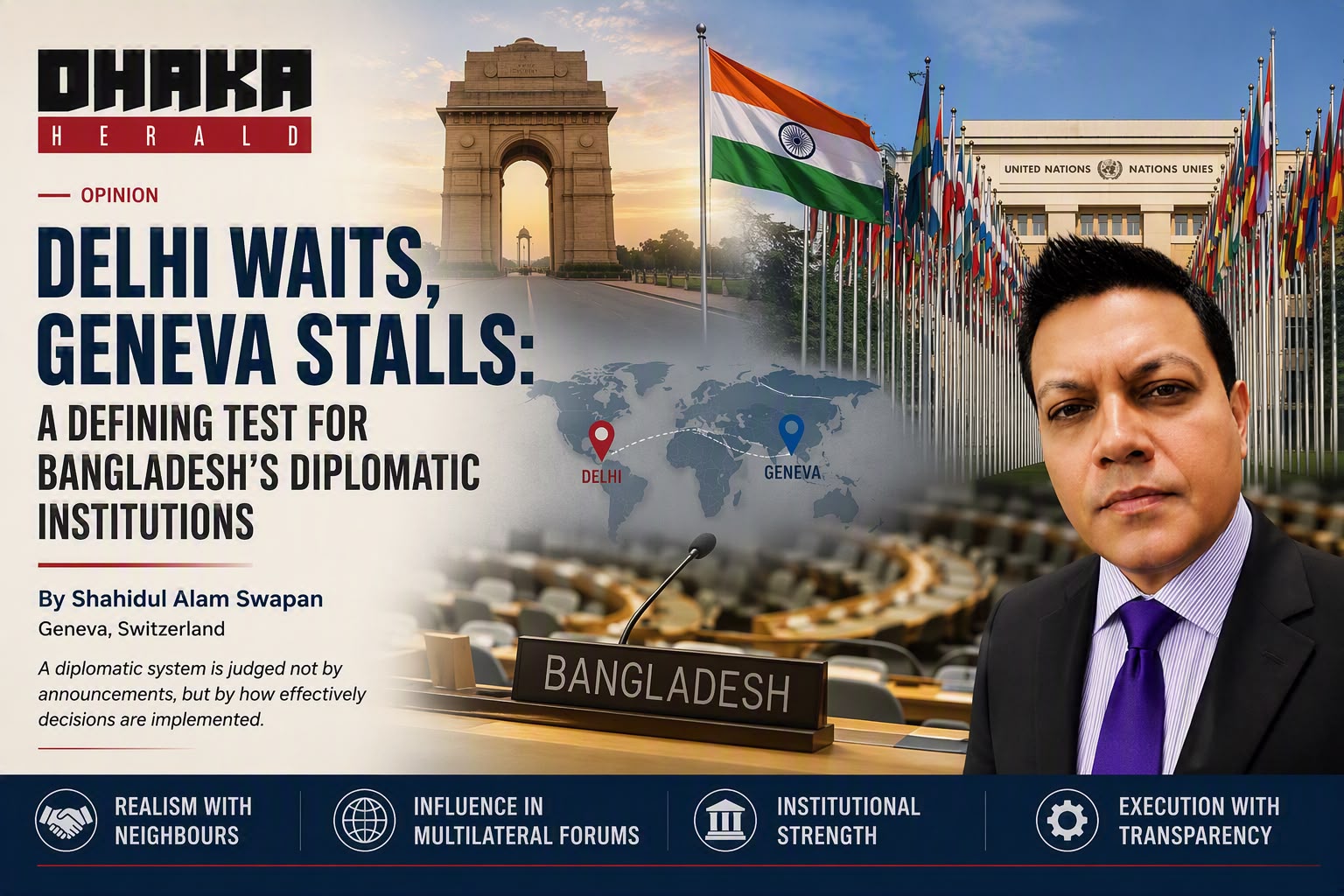
Two recent diplomatic developments involving Bangladesh, one in New Delhi and the other in Geneva, have drawn considerable attention. On the surface, they appear to be routine administrative matters involving ambassadorial appointments and diplomatic reshuffles. Yet together they reveal a more fundamental question: how effectively can Bangladesh translate diplomatic decisions into timely and credible action?
In New Delhi, the reported nomination of seasoned diplomat Asad Alam Siam as Bangladesh's next High Commissioner to India has generated interest, particularly because there has been no public confirmation that India has formally granted agrément, the host country's consent required before such an appointment can take effect.
Meanwhile, reports of a diplomatic reshuffle involving M Riaz Hamidullah, currently Bangladesh's High Commissioner to India, and Nahida Sobhan, Bangladesh's Permanent Representative to the United Nations in Geneva, have yet to culminate in visible transitions or new assignments. According to media reports, Hamidullah is expected to lead Bangladesh's mission in Geneva, while Sobhan is expected to return to Dhaka to head the Foreign Service Academy.
Neither issue should be viewed merely through the lens of personnel changes. They point instead to a broader challenge facing Bangladesh's diplomatic machinery: the need for greater institutional efficiency, transparency and continuity in a rapidly evolving international environment.
Diplomatic appointments are governed by established international norms. Under the Vienna Convention on Diplomatic Relations, a receiving state must approve the appointment of a foreign ambassador or high commissioner before the envoy can formally assume office. Such approval may take time, and host governments are under no obligation to explain delays or refusals.
For that reason, the apparent delay in securing India's consent for Bangladesh's proposed envoy should not automatically be interpreted as a diplomatic setback. International diplomacy often unfolds behind closed doors, shaped by political calculations, strategic considerations and procedural requirements that remain invisible to the public.
Yet diplomacy is as much about perception as it is about formal procedure. Silence can sometimes send signals, even when no official message is intended. Whether the current situation reflects administrative processing, political caution or broader bilateral considerations is impossible to determine without authoritative confirmation. What is clear, however, is that Bangladesh's relationship with India remains too important to be viewed through a narrow political lens.
India is Bangladesh's largest neighbour, a major economic partner and a key stakeholder in issues ranging from trade, energy and connectivity to border management, water sharing and regional security. The relationship is shaped by geographical realities that transcend political cycles.
Governments may change and political atmospheres may fluctuate, but national interests endure. Bangladesh's engagement with India must therefore remain grounded in strategic realism rather than emotional reaction. Differences will inevitably arise between neighbouring countries. The challenge is to manage them without allowing temporary tensions to undermine long-term cooperation.
If New Delhi represents the complexities of bilateral diplomacy, Geneva underscores the growing importance of multilateral engagement.
Geneva is one of the world's most influential diplomatic centres. It hosts the United Nations Human Rights Council, the World Health Organization, the International Labour Organization and numerous other institutions that shape international policy. For Bangladesh, whose economic development and international standing are increasingly linked to issues such as labour standards, migration, human rights, public health, climate resilience and sustainable development, Geneva occupies a position of strategic importance.
The leadership of Bangladesh's mission there is therefore not a routine administrative matter. It affects how effectively the country presents its interests, responds to scrutiny and participates in global negotiations that have direct consequences for its future.
For that reason, reported plans concerning diplomatic leadership in Geneva inevitably attract attention. Not because individuals are being moved from one posting to another, but because the effectiveness of such transitions reflects the strength of the institutions behind them.
The real issue is not who is appointed where. The real issue is how efficiently those appointments are implemented.
In many countries, the gap between decision and execution often becomes a measure of institutional performance. Diplomatic reshuffles involve numerous procedural steps, including government approval, official notifications, host-country acceptance where necessary, administrative preparation, handover arrangements and formal assumption of duties.
Such processes naturally require time. However, in modern diplomacy, clarity and predictability are increasingly important components of state credibility.
International partners, foreign governments and multilateral institutions value continuity. When key appointments remain in prolonged transition, questions can arise regarding timelines, priorities and administrative readiness, even when no substantive problem exists.
This is why transparency matters.
Governments are not expected to disclose every internal deliberation. However, when significant diplomatic appointments become public knowledge, clear communication regarding their progress helps minimise speculation and reinforces confidence in the integrity of state institutions.
The larger lesson emerging from both Delhi and Geneva concerns the evolution of Bangladesh's diplomatic system itself.
Successful diplomacy cannot depend solely on the competence of individual ambassadors.
Talented diplomats undoubtedly matter. They negotiate, build relationships, manage crises and represent national interests. But no country's foreign policy can achieve long-term effectiveness through individual excellence alone. Lasting success depends on institutions capable of ensuring continuity regardless of who occupies a particular office at any given moment.
The world's most effective diplomatic services are built around systems rather than personalities. Leadership transitions are planned in advance. Policy priorities remain consistent. Successors receive clear mandates. Administrative procedures function smoothly. Strategic objectives survive political and bureaucratic change.
Bangladesh has made notable progress in strengthening its diplomatic service over recent decades. Its diplomats today operate in a far more complex environment than previous generations, navigating geopolitical competition, economic uncertainty, technological disruption and shifting global alliances. The demands placed upon the foreign service have never been greater.
That reality makes institutional discipline even more important.
Diplomatic credibility increasingly depends not only on policy vision but also on the state's ability to implement decisions efficiently. An appointment announced but not completed, a transition planned but not executed, or a decision taken but not communicated effectively can all create avoidable uncertainty.
This discussion also highlights a broader dimension of Bangladesh's foreign policy. While India will remain a critical partner, Bangladesh's diplomatic interests extend far beyond a single bilateral relationship.
The country's future prosperity and strategic autonomy depend on balanced engagement with multiple partners, including China, the United States, the European Union, Japan, the Gulf states and emerging economies across Asia and beyond. Effective diplomacy requires diversification, pragmatism and flexibility.
Excessive dependence on any one power creates vulnerabilities. At the same time, disagreement with a partner should never translate into permanent estrangement. The most successful foreign policies are those that preserve room for engagement even when differences exist.
Bangladesh's diplomatic challenge, therefore, is not choosing between relationships but managing them simultaneously and effectively. It requires a foreign policy that embraces cooperation without dependency, strategic engagement without alignment pressures and national interests without unnecessary confrontation.
Ultimately, the issue before Bangladesh is larger than appointments in Delhi or Geneva.
The real test is whether the country can strengthen the institutions that support its diplomacy.
India's consent rests with New Delhi. The implementation of Bangladesh's diplomatic decisions rests with Dhaka. That distinction is important.
In an increasingly competitive international environment, credibility is measured not only by strategic ambitions but by administrative execution. Nations earn trust when their institutions demonstrate consistency, predictability and professionalism.
Delhi's silence may reflect India's diplomatic calculations. Geneva's delay, however, should not become a reflection of Bangladesh's own institutional weaknesses.
Strong diplomacy is not defined by individual diplomats alone. It is sustained by strong institutions, transparent processes, timely implementation and a clear sense of national purpose. Governments change, ambassadors rotate and political circumstances evolve. Institutions must endure.
That may well be the most important diplomatic challenge facing Bangladesh today.
Shahidul Alam Swapan is a Geneva-based political analyst, financial crime compliance specialist in private banking, columnist and poet. He writes on South Asian geopolitics, international affairs, global financial integrity and strategic affairs.
Email: shahidul.alam@bluewin.ch