
Liquidity Piles Up, but Businesses Shun Bank Loans
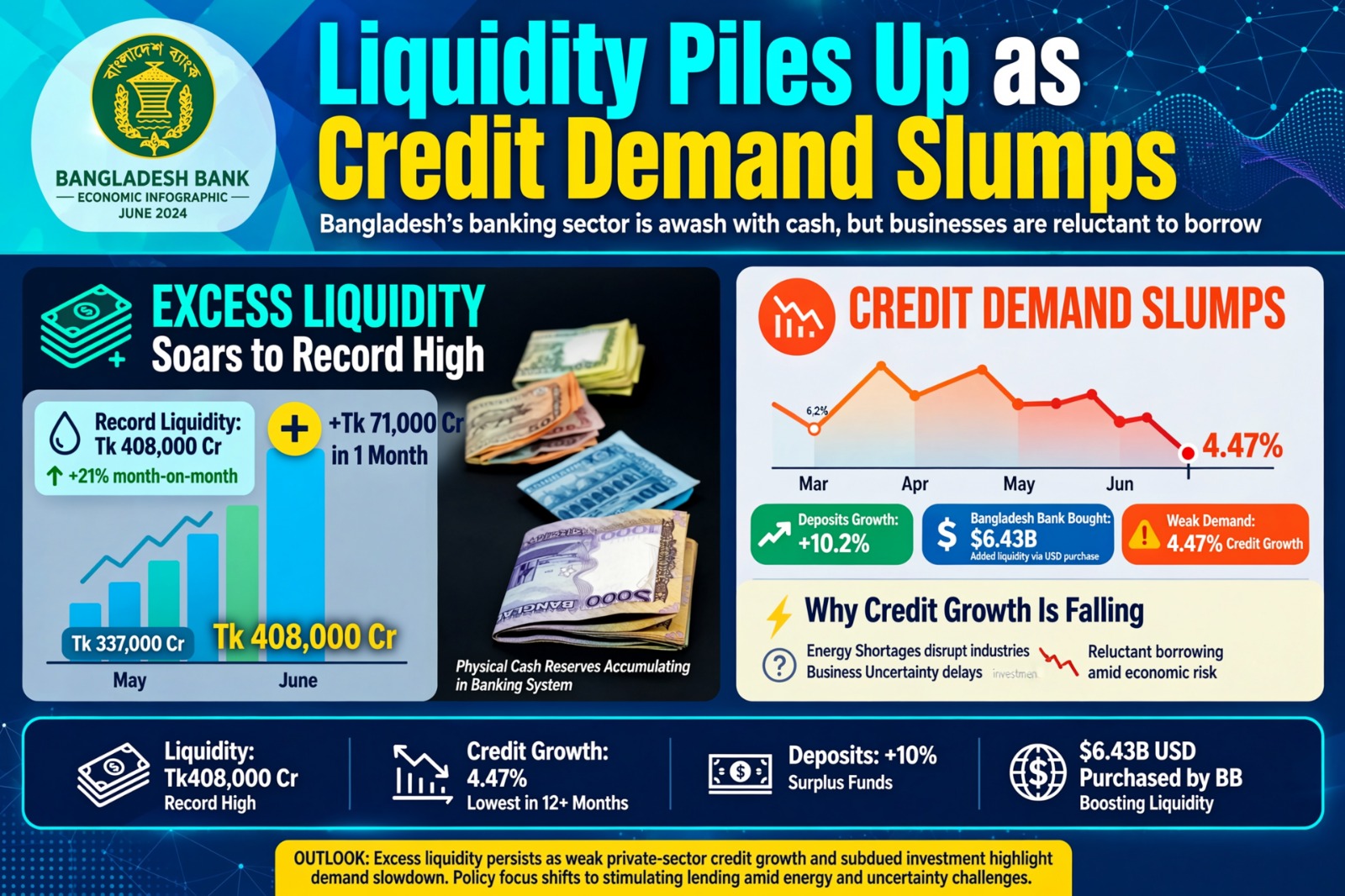
Bangladesh’s banking sector is awash with money, yet businesses are increasingly reluctant to borrow, signalling deepening weakness in investment and economic activity.
Excess liquidity in banks rose to a record Tk408,000 crore in June, from Tk337,000 crore in May—an increase of Tk71,000 crore in a single month. At the same time, private-sector credit growth fell to just 4.47 per cent in June, from 4.98 per cent in May. Deposit growth, meanwhile, remained above 10 per cent.
The widening gap suggests that the problem is no longer a shortage of funds. Businesses are holding back because of weak demand, high production costs, unreliable gas and electricity supplies and uncertainty over the investment climate.
Toufiq Ahmed Chowdhury, former director general of the Bangladesh Institute of Bank Management, said credit growth below 5 per cent was a worrying signal. Cutting interest rates alone, he argued, would not revive investment unless demand and the broader business environment improved.
Bangladesh Bank has reduced its policy rate from 10 per cent to 9.5 per cent, while also introducing a Tk60,000 crore incentive package, raising the lending ceiling for large borrowers from 15 per cent to 25 per cent and limiting banks’ lending spread to 4 per cent.
Yet banks themselves are becoming more cautious after years of rising bad loans. Many now prefer relatively safer government securities to lending to businesses, creating a potential crowding-out effect.
Liquidity has also been boosted by Bangladesh Bank’s foreign-exchange purchases. The central bank bought a net $6.43 billion from the market during 2025-26, injecting additional taka into the banking system.
Interbank borrowing has also fallen sharply. Combined borrowing through call money, interbank repo and central bank repo declined from about Tk397,000 crore in June to Tk280,000 crore in July, a drop of roughly Tk118,000 crore. Call-money turnover fell 4.57 per cent, while interbank repo turnover declined 20.72 per cent.
The figures point to an economy suffering not from a lack of money, but from a lack of confidence.
Unless energy supplies improve, business costs fall and consumer demand and investment confidence recover, Bangladesh’s Tk408,000 crore liquidity mountain may remain trapped inside the banking system rather than flowing into factories, jobs and economic growth.