
BEYOND FARAKKA
Bangladesh's Strategic Roadmap for the 2026 Ganges Treaty
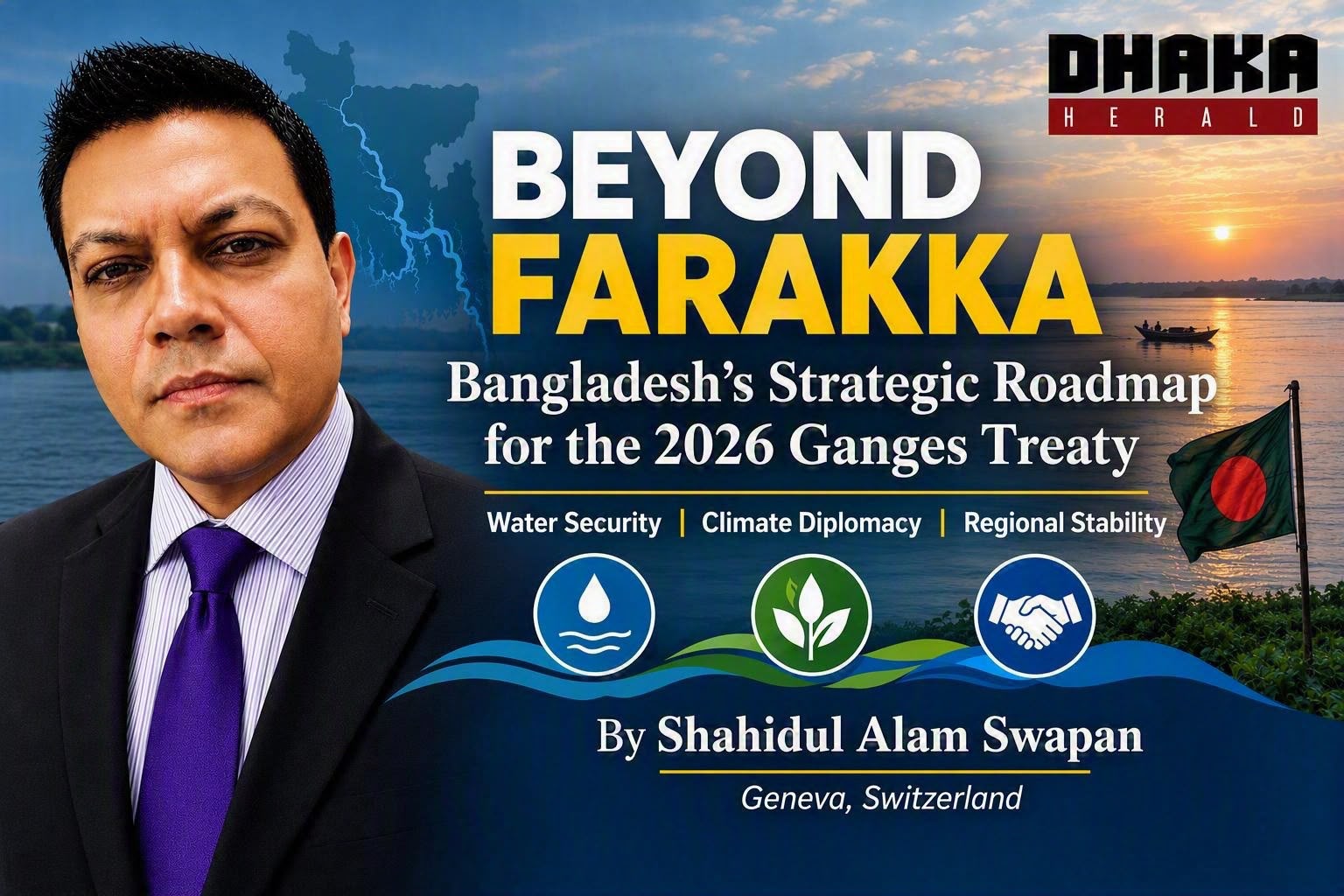
The future of South Asia will be shaped not by how nations divide scarcity, but by how they build cooperation around shared rivers.
A Defining Moment for Bangladesh and South Asia
When Indian External Affairs Minister S. Jaishankar recently stated that Bihar's interests would be considered before renewing the 1996 Ganges Water Sharing Treaty, his remarks reflected the realities of India's federal political system. No democratic government can ignore the concerns of farmers, businesses, local communities, and state governments when negotiating international agreements.
For Bangladesh, however, the central question is not whether Bihar should be consulted. The real concern is whether the legitimate interests of an upstream Indian state could ultimately be used to justify reducing the legitimate water rights of a downstream sovereign nation.
As the thirty-year Ganges Treaty approaches expiration in December 2026, South Asia finds itself at a crucial strategic crossroads. Decisions taken over the next year will shape not only Bangladesh-India relations but also the future of regional cooperation in an era increasingly defined by climate stress, water insecurity, and environmental disruption.
The upcoming negotiations are therefore about far more than a treaty. They represent a test of whether South Asia can move beyond short-term political calculations and embrace a modern, science-based framework for managing shared natural resources.
Why the Stakes Have Never Been Higher
Water is rapidly emerging as one of the most important geopolitical resources of the twenty-first century. Across the world, disputes over rivers are becoming increasingly influential in shaping national security, economic development, food production, and environmental sustainability.
South Asia is particularly vulnerable. Climate change is altering rainfall patterns, glaciers feeding major river systems are retreating, urban populations are expanding, and industrial demand for water continues to rise. Every factor points to a future in which pressure on freshwater resources will intensify.
For Bangladesh, the Ganges is not simply a river. It is an economic artery, an ecological lifeline, and a critical pillar of national resilience. Reduced dry-season flows have direct implications for agriculture, food security, inland navigation, fisheries, groundwater recharge, and the ecological health of the Sundarbans.
The consequences extend well beyond irrigation. They affect public health, livelihoods, employment opportunities, migration patterns, and the long-term sustainability of vulnerable coastal communities already facing the impacts of climate change.
This is why the 2026 treaty renewal matters. It is not simply about water. It is about the future of millions of people.
Bangladesh Must Change the Conversation
For decades, discussions surrounding the Ganges have largely focused on dividing available water. While allocation remains important, this framework is increasingly inadequate.
Bangladesh should seek to transform the conversation from one centred on sharing scarcity to one focused on increasing availability.
That distinction is critical.
Negotiations that revolve solely around how to divide an increasingly limited resource inevitably create winners and losers. By contrast, a strategy aimed at increasing dry-season flows offers the potential for mutual gains. Rather than arguing over a shrinking pie, both countries should work together to enlarge it.
Such an approach would represent a major shift in regional water diplomacy and could redefine how South Asia manages shared rivers.
Building a Science-Based Negotiating Platform
Bangladesh's strongest diplomatic asset is not rhetoric but evidence.
The government should bring together hydrologists, climate scientists, environmental economists, river engineers, agricultural specialists, and international water law experts to develop one of the most comprehensive water diplomacy strategies in the country's history.
A data-driven assessment should clearly quantify the economic and environmental costs associated with reduced dry-season flows. This includes agricultural losses, fisheries decline, salinity intrusion, navigation difficulties, groundwater depletion, and threats to the Sundarbans ecosystem.
Scientific evidence carries weight in international negotiations. Detailed and transparent research significantly strengthens Bangladesh's credibility while ensuring the debate remains focused on facts rather than political narratives.
Internationalizing Principles Rather Than Disputes
Bangladesh should avoid framing the issue as a bilateral confrontation. Such an approach would likely reduce diplomatic flexibility and limit opportunities for constructive engagement.
Instead, Dhaka should consistently anchor its position in internationally recognised principles governing transboundary rivers. These include equitable and reasonable utilisation, the obligation to avoid significant harm to downstream states, prior notification for major water infrastructure projects, and the importance of transparent data sharing.
By focusing on globally accepted norms rather than emotional arguments, Bangladesh can strengthen its moral authority while presenting itself as a responsible advocate of rules-based cooperation.
Recognizing Environmental Flows
One of the limitations of many historical water-sharing arrangements is that they often ignore the needs of the river itself.
Rivers require minimum flows to sustain ecosystems, maintain biodiversity, support fisheries, and preserve natural hydrological functions. Future negotiations should therefore include clear provisions recognising environmental flow requirements.
Such recognition would not only benefit Bangladesh but also support ecological sustainability across the broader Ganges basin. A healthy river system ultimately serves the interests of both upstream and downstream populations.
Strengthening Transparency Through Technology
Trust is impossible without transparency.
Bangladesh should advocate the establishment of an advanced, technology-driven monitoring framework capable of providing real-time water flow information to both countries.
Modern satellite systems, automated monitoring stations, digital data platforms, artificial intelligence-supported river modelling, and publicly accessible reporting mechanisms can substantially reduce disputes over data accuracy and interpretation.
Shared facts create shared understanding. Shared understanding creates confidence. Confidence creates stability.
A twenty-first century river agreement should be supported by twenty-first century technology.
Bringing Nepal into the Long-Term Solution
The future of Ganges basin management cannot rest solely on discussions between Bangladesh and India.
Nepal occupies an important strategic position within the broader basin and possesses significant potential for water storage, hydropower generation, seasonal flow regulation, and flood management.
A long-term trilateral framework involving Bangladesh, India, and Nepal could deliver multiple benefits simultaneously. Such cooperation could improve flood control during the monsoon season, increase dry-season flows, expand renewable energy production, strengthen regional power trade, and enhance climate resilience across the entire basin.
If pursued responsibly and transparently, it could become one of South Asia's most successful examples of regional integration.
Lessons from the Teesta Experience
Bangladesh has already witnessed how domestic political considerations within India can delay the implementation of a major water-sharing agreement.
The Teesta issue offers an important cautionary lesson.
Dhaka should therefore seek legally robust implementation mechanisms for any renewed Ganges agreement. These should include clear review procedures, dispute resolution frameworks, monitoring arrangements, and commitments that remain effective regardless of changes in political leadership.
A treaty's value ultimately depends not on what it promises but on what it delivers.
Building Quiet but Effective International Support
Bangladesh does not need international confrontation. It needs international credibility.
The country should increase engagement with global water governance experts, climate institutions, academic networks, development partners, and international research organisations. Such engagement can help strengthen Bangladesh's technical capacity while drawing attention to the broader implications of sustainable river management.
The objective should not be to isolate India. Rather, it should be to reinforce a cooperative framework that serves the interests of all stakeholders.
Constructive diplomacy consistently delivers better results than public confrontation.
Why India Also Has Much to Gain
Water-sharing debates are often portrayed as zero-sum contests. In reality, they increasingly affect wider strategic relationships.
Bangladesh's importance to India's regional interests continues to grow. Connectivity projects, trade expansion, energy cooperation, maritime security, regional logistics, and access to the Bay of Bengal have all deepened bilateral interdependence.
A perception of unfairness regarding water allocation could weaken public confidence and complicate cooperation in a range of other sectors. Conversely, a fair and forward-looking agreement would strengthen mutual trust and reinforce India's image as a responsible regional power capable of balancing domestic pressures with international obligations.
The River Is the Real Stakeholder
Perhaps the greatest mistake in South Asian water politics has been treating rivers solely as political assets.
Neither Bihar nor Bangladesh will benefit from a declining Ganges.
The future debate must therefore move beyond questions about who receives a larger share during a specific period. The real challenge is ensuring sustainable river flows, improving irrigation efficiency, managing sediment more effectively, adapting to climate change, and preserving ecological health.
Only then can both countries secure long-term prosperity.
A Historic Opportunity
The 2026 Ganges Treaty renewal presents Bangladesh with a historic opportunity.
Dhaka can choose a narrow strategy focused exclusively on defending existing allocations, or it can champion a broader vision rooted in science, transparency, sustainability, and regional cooperation.
That vision should connect water security with climate adaptation, renewable energy, environmental protection, food security, and economic development. It should recognise that the future of South Asia will depend increasingly on how countries manage shared natural resources.
The Ganges can become another source of tension in an already fragile region. Equally, it can become a model for modern cooperation and a blueprint for managing transboundary rivers in an age of climate uncertainty.
The choice confronting policymakers in Dhaka and New Delhi is therefore not simply about water.
It is about whether South Asia's most important river becomes a symbol of division or a bridge of shared prosperity.
History will judge the wisdom of that decision.
The concerns of Bihar deserve to be heard. So do the concerns of millions living along the banks of the Padma and throughout Bangladesh's river-dependent regions.
The Ganges belongs to neither country alone. It is a shared river, a shared responsibility, and ultimately a shared future.
The 2026 treaty renewal offers South Asia a rare opportunity to demonstrate that cooperation is stronger than competition, that science is stronger than politics, and that rivers can unite nations rather than divide them.
(Shahidul Alam Swapan Geneva-Based Political Analyst, Columnist, and Specialist in Global Financial Integrity, Strategic Security, and South Asian Geopolitics.)