
Beyond Hasina
Why India must learn to deal with Bangladesh, not a favourite leader
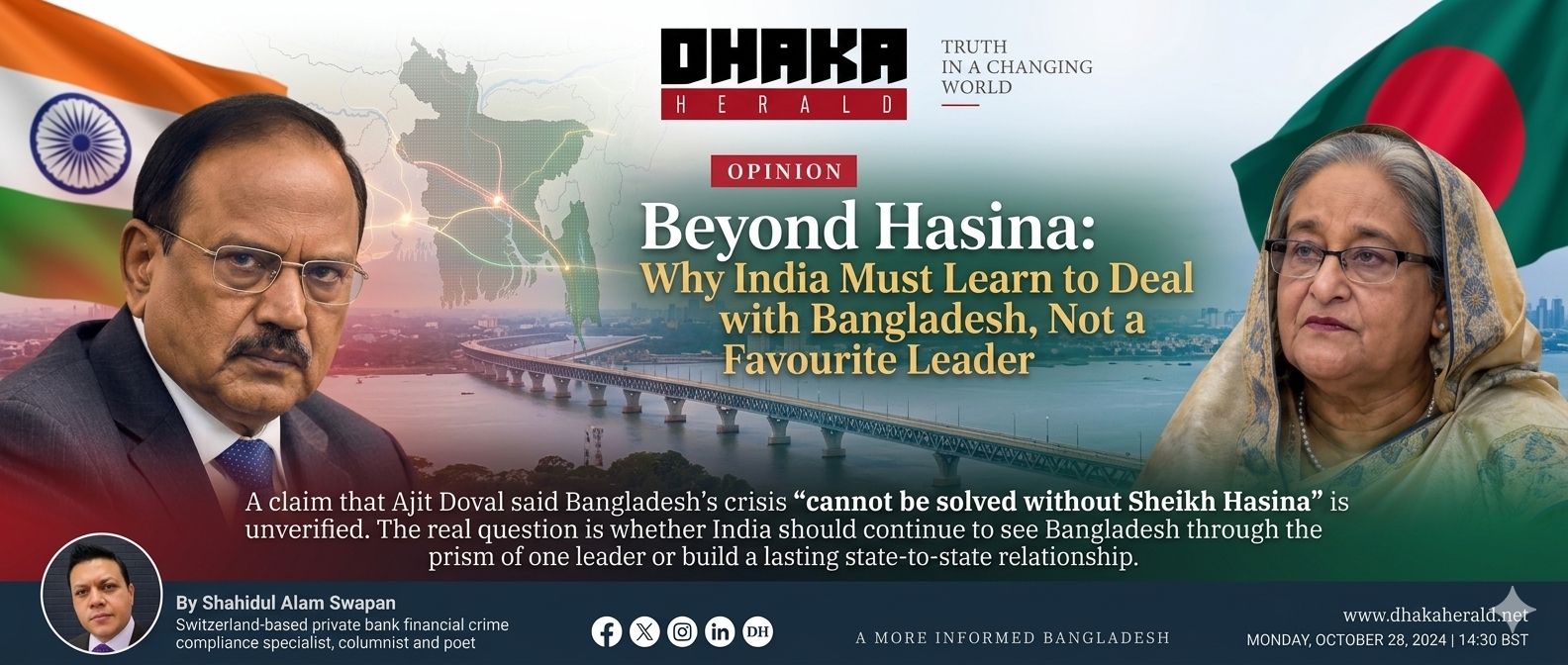
A claim circulating in Bangla-language media that Indian National Security Adviser Ajit Doval believes Bangladesh’s political and administrative problems “cannot be solved without Sheikh Hasina” deserves attention, but also caution.
Before analysing its political significance, an important distinction must be made between fact and attribution.
There is ample evidence that Ajit Doval has been closely involved in India’s handling of developments surrounding Sheikh Hasina. When she left Bangladesh on 5 August 2024 and arrived at Hindon Air Base near New Delhi, Doval personally received her and discussed the situation in Bangladesh with her. Indian security agencies were deeply engaged in assessing the implications of the dramatic political transition next door.
What cannot presently be established from credible public sources, however, is that Doval has recently declared that Bangladesh cannot overcome its problems without Sheikh Hasina. Searches of major Indian and international news sources and publicly available Indian government material do not provide reliable confirmation of such a statement.
That distinction matters.
A statement attributed to one of India’s most powerful security officials should not be treated as established fact simply because it fits an existing geopolitical narrative. If Doval made such an assessment privately, that is one matter. If he made it publicly, there should be a verifiable speech, interview, official briefing or credible report establishing when, where and in what context he said it.
Nevertheless, the controversy raises a much more important question for India and Bangladesh: Can India’s Bangladesh policy afford to remain associated with one political leader?
For New Delhi, Sheikh Hasina was unquestionably an important strategic partner. During her long period in government, security cooperation between Bangladesh and India expanded significantly. Indian policymakers particularly valued Dhaka’s actions against insurgent organisations that had historically exploited territory across the border and threatened India’s northeastern states.
That history helps explain why Hasina acquired extraordinary strategic importance in Indian security thinking. Contemporary Indian commentary following her fall also portrayed her government as having provided New Delhi with valuable stability on its eastern frontier.
But strategic gratitude and strategic dependence are two different things.
India may legitimately recognise the security cooperation it received from Hasina’s government. It would be far more problematic, however, to conclude that Bangladesh itself is governable only through Sheikh Hasina.
Bangladesh is a sovereign state of around 170 million people, not an extension of India’s northeastern security architecture. Its political legitimacy must ultimately come from Bangladeshis.
More importantly, Bangladesh has already moved into another political phase.
The country held a national election in February 2026. The Bangladesh Nationalist Party won a commanding parliamentary majority, and Tarique Rahman was sworn in as prime minister on 17 February. His government now carries responsibility for restoring political stability, strengthening institutions, attracting investment and managing Bangladesh’s international relationships.
Any contemporary assessment suggesting that Bangladesh simply exists in a leadership vacuum until Hasina returns therefore overlooks an important political reality.
Bangladesh certainly faces serious challenges. Political polarisation, institutional weakness, law and order, economic pressures, investor confidence and the rebuilding of democratic institutions remain significant issues. Prime Minister Rahman himself acknowledged after his election victory that the country faced a fragile economy, weakened institutions and deteriorating law and order.
But recognising those difficulties is very different from concluding that one former prime minister represents the only possible solution.
Indeed, such thinking could become counterproductive for India itself.
For years, one of the weaknesses of Indian diplomacy toward Bangladesh was the widespread perception among many Bangladeshis that New Delhi’s relationship with Dhaka had become excessively intertwined with Sheikh Hasina and the Awami League.
Whether every aspect of that perception was justified is almost beside the point. In international relations, perceptions eventually acquire political consequences.
India therefore has an opportunity to recalibrate.
Prime Minister Tarique Rahman’s recent position offers an opening. In August, he called for a “conducive environment” for stronger Bangladesh-India relations while meeting India’s new High Commissioner. India, meanwhile, has continued signalling its desire for constructive engagement with Dhaka.
This is where the future should begin.
India’s legitimate security concerns should not be dismissed. New Delhi has every reason to worry about cross-border militancy, extremist networks, trafficking, instability along a 4,000-kilometre-plus frontier and security threats affecting its northeastern states.
Bangladesh has equally legitimate concerns: equitable water sharing, border killings, trade imbalances, connectivity, sovereignty, treatment of Bangladeshi citizens and the unresolved question of Sheikh Hasina’s presence in India.
Neither side benefits when these issues become hostage to partisan politics.
The mature strategic approach is therefore neither “pro-Hasina” nor “anti-Hasina”. It is pro-Bangladesh-India relations.
For India, this means accepting that governments in Dhaka will change. Political parties will rise and fall. Leaders will come and go. India’s geography, however, will not change, and neither will Bangladesh’s.
For Bangladesh, it means recognising that India is not simply another foreign partner. Geography makes cooperation unavoidable. Water, trade, energy, transit, border management, maritime security and regional connectivity bind the two countries together regardless of which parties govern in Dhaka or New Delhi.
There is another reason India should avoid personalising its Bangladesh policy.
South Asia is entering an era of sharper geopolitical competition. China is already a major economic and strategic actor in Bangladesh. The United States, European Union, Japan, Türkiye and Gulf states are also expanding their engagement across the region. Bangladesh itself increasingly seeks diversified partnerships rather than dependence on any single external power.
If New Delhi appears unable to separate its relationship with Bangladesh from its relationship with Sheikh Hasina, it risks voluntarily surrendering diplomatic space to other powers.
That would be an extraordinary strategic mistake.
India’s long-term security will not be protected by ensuring that Bangladesh has a government New Delhi prefers. It will be better protected when Bangladesh has stable institutions, legitimate political processes, economic prosperity and a population that views cooperation with India as beneficial rather than imposed.
The controversy surrounding the alleged Doval statement therefore contains an important lesson even if the quotation itself remains unverified.
Sheikh Hasina is undeniably part of Bangladesh’s political history and remains a consequential political figure. India also has legitimate reasons to remember the security cooperation achieved during her years in office.
But Bangladesh is larger than Sheikh Hasina, just as India is larger than Narendra Modi or any other individual leader.
The strongest relationship between neighbours is not one that survives because two leaders trust each other. It is one that survives when governments change.
New Delhi’s challenge today is therefore not to determine how Bangladesh can return to the political arrangements of the past. It is to understand the Bangladesh that exists now.
And Dhaka’s challenge is to demonstrate that constructive relations with India can coexist with sovereignty, political independence and diversified international partnerships.
The future of Bangladesh-India relations should ultimately be built neither around Sheikh Hasina nor Tarique Rahman.
It should be built around Bangladesh and India.